Structured Cabling,Washington DC New York City

The 5 Most Common Structured Cabling Errors – Part 2

28 Oct 2017

Structured Cabling,Washington DC New York CityAs mentioned in Part 1, structured cabling systems are so standardized that good practices should merely entail following ISO/IEC, CENELEC or Telecommunications Industry Association (TIA) documentation. Part 2 will discuss three more common errors of structured cabling.


Error No. 3


Failing to properly test a structured cabling system after installation is the third error. Structured cabling represents a large commitment of capital expenditure and will typically have the same length of service life as the facility itself. Ensuring that the entire system is installed to specification and the data is at the capacity and speed expected is crucial. Finally, properly testing the cabling system is required to validate the warranty.


Cables installed during the early period of construction may have been subsequently damaged by other workers performing their roles later during the project. Moreover, new cables that appear fine on the exterior may actually be faulty because of damage underneath the coating as a result of being mishandled. All cables require calibrated testing.


Error No. 4


Using unqualified technicians for installation is the fourth error. Scrimping on the quality of workers installing cabling is an unwise way to save money. Problems will eventually be revealed over time. Prior to committing to a service contract with a structured cabling service, review their credentials and confirm their references. Have conversations with previous customers whose project is similar in scope to yours. Working with a reputable structured cabling firm will help make sure your project will be successful for the long term.


Error No. 5


Letting structured cabling patch panels become disorganized is the fifth error. It will harm both the performance and reliability of a company’s IT systems. As time passes, the patch panel or switch ports may be damaged, causing intermittent problems that are very hard to pinpoint. The use of proper cable management hardware for supporting patch cables is good practice. Complying with the specified patching standards required for a particular structured cabling system will result in a sound and reliable network.


Progressive Office Cabling


Founded in 1986, Progressive Office’s success has been a direct result of years of commitment to seeking solutions on behalf of our clients in the Washington, D.C. and New York City areas. Efficiently working together, Progressive teams get cabling installed and operating as fast as possible while minimizing disruption and downtime. Call our toll free number (800) 614-4560 today.
Structured Cabling, Cabling, Washington DC

The 5 Most Common Structured Cabling Errors – Part 1

19 Oct 2017

Structured Cabling, cablesStructured cabling systems are so standardized that good practices should merely entail following ISO/IEC, CENELEC or Telecommunications Industry Association (TIA) documentation for panel and outlet standards, cable pathway standards, maximum cable and patch cord lengths, patch testing standards, etc. Strictly doing so will invariably result in an installation that is professional and trouble free. In addition, as data speeds grow faster and faster, following industry standards becomes even more crucial.


Improperly installed cabling made up of shorter runs, which do not overly stress the system, may function well enough. In addition, data speeds may be quite beneath the cable specification capacity. As an example, CAT5e carrying 100Mbps and capable of 1Gbps will have ample margin of error. However, structured cabling systems still need qualified technicians for proper installation supporting maximum data speeds over the entire network as required.


The following will discuss the five most common errors of structured cabling. Remember to call an experienced and expert cabling installation team to get the best results for your company’s project.


Error No. 1


Considering cables as merely wiring is the first error. They are actually very important electronic components that provide the pathway for data from point to point within a network. These points may be a desktop PC, a network switch, server, router, and wireless access point. When you consider that cables make these connections possible, then you can understand how important it is to make sure that the cabling is of high quality and properly installed.


Error No. 2


Running data cables near power cables is the second error. Even when cables are screened, this practice is unsound. When data cables are running near and parallel to   power cables, noise emitted by power cables may infiltrate data cables. As the load carried by power cables fluctuate, resulting spikes or surges may radiate into the data cables, creating undesired noise decreasing the quality of the data transmission.


Part 2 will discuss three more common errors of structured cabling.


Progressive Office Cabling


Founded in 1986, Progressive Office’s success has been a direct result of years of commitment to seeking solutions on behalf of our clients in the Washington, D.C. and New York City areas. Efficiently working together, Progressive teams get cabling installed and operating as fast as possible while minimizing disruption and downtime. Call our toll free number (800) 614-4560 today.
Cabling, network cabling, cable Installations

Fiber Optic Cabling for Your Business – Part 2

14 Oct 2017

Fiber Optic Advantages


Cabling, network cabling, cable InstallationsAs discussed in Part 1, fiber cables provide a number of advantages that make them superior to copper cables. This includes longer distance effectiveness, greater bandwidth capacity, resistance to electromagnetic interference, safer usage, and stronger security. Part 2 will discuss how fiber optic functions, its two main types, and fiber networks.


How Fiber Optic Cables Function


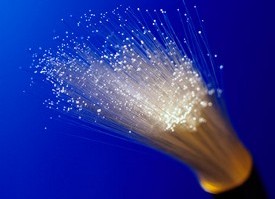
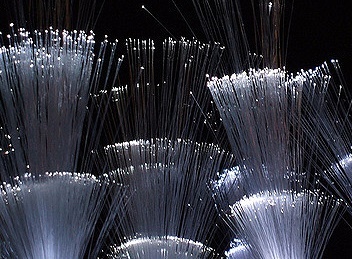
Fiber optic cables transmit data through the generation of pulses of light by light-emitting diodes (LEDs) or lasers. A fiber optic cable is composed of either a single strand or several strands of glass, each measuring slightly thicker than human hair.


The core is located in every filament’s center, and it is where light travels. Covered by cladding made of a glass layer, the core is able to reflect light inward, preventing signal loss and letting light travel through the cable’s bends.


Two Main Types


There are two main types of fiber optic cabling, single mode and multimode. Using extremely thin glass filaments, single mode fiber optic uses a laser to generate pulses of light, while multimode utilizes LEDs.


By utilizing the technique of Wave Division Multiplexing (WDM), single mode fiber networks raise the volume of data traffic transmitted over a filament. Combining light at various wavelengths is termed multiplexing, while separating them is called de-multiplexing. Thus, several streams of communication can be transmitted on a single pulse of light.


Fiber Networks


The installation of the majority of fiber cabling is intended to support long distance connections between national and international geographical locations. However, a number of internet service providers (ISPs) have made investments in the expansion of fiber to provide direct access to homes in suburban neighborhoods. These are termed "last mile" installations.


FTTH (Fiber to the Home) services, such as Google Fiber and Verizon FIOS, are becoming more common. They can provide homes with gigabit (1 Gbps) internet speeds. Direct fiber cabling runs directly from a main office to a single client, providing maximum bandwidth. In contrast, shared fiber cabling is ultimately distributed among several groups of users who are in close proximity.


Progressive Office Cabling


Founded in 1986, Progressive Office’s success has been a direct result of years of commitment to seeking solutions on behalf of our clients in the Washington, D.C. and New York City areas. Efficiently working together, Progressive teams get cabling installed and operating as fast as possible while minimizing disruption and downtime. Call our toll free number (800) 614-4560 today.
Technology,Network Cabling, cables

Fiber Optic Cabling for Your Business – Part 1

8 Oct 2017

Technology,Network Cabling, cablesThe widespread use of fiber optic cabling stems from 1950s research. These studies eventually made transmitting visible images via glass filament possible. This new technology was eventually used for viewing instruments and remote illumination for surgery. Subsequently, George Hockham and Charles Kao successfully achieved data transmission through glass fiber in 1966.


Fiber optic cabling is composed of glass fiber filaments housed within insulated casing, and these cables were designed for long distance, large capacity, and high performance data networking and telecommunications. In comparison to wired cables, fiber optic has high-bandwidth capability and is capable of data transmission over longer distances. Due to these properties, fiber optic cabling is used for a great portion of telephone, internet, and cable television systems around the world.


Fiber Optic Advantages


Fiber cables provide a number of advantages that make them superior to copper cabling. Due to properties of high bandwidth and low-loss, fiber optic cabling can be utilized over much greater distances than copper cables. Fiber optic cables can run up to 2 kilometers for data networks without repeaters. This is because light can travel much further on fiber cable and still retain its strength.


Fiber optic cables have greater capacity. Through the use of multiplexers, a single fiber optic cable can have the same network bandwidth as several hundred copper cables. It is now standard for fiber cables to be rated at 10 Gbps, 40 Gbps, and 100 Gbps.


Although it has special shielding as protection against electromagnetic interference, copper network cable is still susceptible when numerous cables are close to each other. This is in contrast to the physical properties of the glass used in fiber optic cables.


Fiber optic is also safer to use than copper in volatile spaces, where sparks can lead to disaster. It also has the upper hand in terms of security because tapping fiber cable to steal data transmission is very difficult.


Part 2 will discuss how fiber optic functions, its two main types, and fiber networks.


Progressive Office Cabling


Founded in 1986, Progressive Office’s success has been a direct result of years of commitment to seeking solutions on behalf of our clients in the Washington, D.C. and New York City areas. Efficiently working together, Progressive teams get cabling installed and operating as fast as possible while minimizing disruption and downtime. Call our toll free number (800) 614-4560 today.