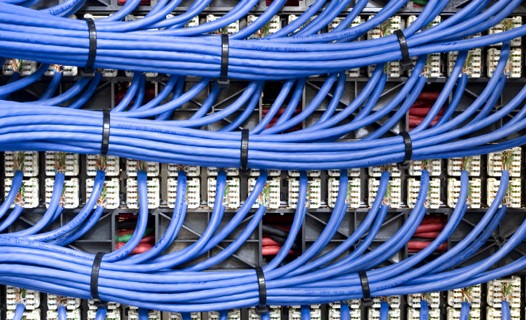
Office Cabling Network Cabling

The Principles of Network Design – Part 4

29 Mar 2018

Office Cabling Network CablingAs discussed in Part 3, a company’s network design should help the organization meet its Business Requirements, give it Business Continuity capability, and provide the adequate Elasticity to allow it to cope with business developments. Part 4 will cover How IT Enables Business Innovation.


How IT Enables Business Innovation


Modern businesses use IT technology to innovate and improve their customer service. When an emerging technology can enable a company to be more competitive in the marketplace and raise customer satisfaction, it will be typically acquired by the business, and its features will be integrated into its network.


A great example of the above is the rapid growth of cloud-based data centers, which are allowing new companies to drastically decrease their capital expenditure and allowing their scaling at will. However, they will still require a high performing data center that has the qualities of flexibility and reliability.


Requirements


A company’s industry and how it began will help a network designer to quickly grasp its underlying requirements. It is obvious banking will certainly need information security. Thus, the network design for banking has to provide the required security capabilities to be adopted by the industry. Moreover, a designer must keep in mind the industry’s standards that are applicable to IT infrastructure and services.


Priorities


Every organization makes priorities that revolve around its business objectives. They should be factored in an IT network infrastructure’s planning and design. Keeping in mind a company’s priorities will help produce a network that successfully supports its business activities.


Suppose an organization’s network for business communication requires (as numbered in importance of priority): 1) collaboration, 2) interactivity, and 3) mobile access. Accordingly, the first two features required must be provided prior to satisfying the third requirement.


In conclusion, a network designer must be cognizant of a company’s business priorities in order to be able to successfully create a network that serves its needs.


Progressive Office Cabling


Founded in 1986, Progressive Office’s success has been a direct result of years of commitment to seeking solutions on behalf of our clients in the Washington, D.C. and New York City areas. Efficiently working together, Progressive teams get cabling installed and operating as fast as possible while minimizing disruption and downtime. Call our toll free number (800) 614-4560 today.

Network Cabling, Structured Cabling

The Principles of Network Design – Part 3

24 Mar 2018

Network Cabling, Structured CablingAs discussed in Part 2, Top-Down Logic is used for the process of Preparation, Planning, Design, Implementation, Operation, and Optimization (PPDIOO). In addition, network designers must determine the Scope of Design prior to the collection of data and planning. Part 3 will cover Business Requirements, Continuity, and Elasticity.



Requirements


Figuring out what an organization needs requires having an understanding of its current objectives, mission statement, and future plans. Knowledge of these should guide the business-driven aspects of the network design. Using a top-down approach, a business’s goals, drivers, requirements, continuity, and strategy will determine its business applications, technical and functional requirements, and network infrastructure solutions.


Continuity


Business continuity is a company’s ability to continue doing business after a system outage caused by a man-made or natural disaster that has damaged a data center. An organization needs a disaster recovery plan to develop its resiliency in the face of such disasters. Various parts of its network may need to be more resilient due to regulatory compliance.


Elasticity


Elasticity is an organization’s level of flexibility when responding to business developments. This typically refers to a change in business objectives or conditions, including growth, recession, merger, acquisition, etc. Therefore, a company’s network design must have adequate flexibility in order to fulfill its business requirements and strategic goals. A designer’s comprehension of the overall trends of the organization’s business sector will provide valuable guidance in the design’s features that provide flexibility.


The design of a network must give an organization the flexibility that will allow it to perform integrations with other networks. This will usually be required when mergers and acquisitions take place. It is important to note that during a merger or acquisition, the network may undergo considerable growth during a very brief period. In such circumstances, the most daunting challenge for network designers is having to handle the various design principles, conflicting control plane protocols, and overlaps in IP address spaces of the networks being integrated.


Part 4 will cover “How IT Enables Business Innovation.”

Progressive Office Cabling


Founded in 1986, Progressive Office’s success has been a direct result of years of commitment to seeking solutions on behalf of our clients in the Washington, D.C. and New York City areas. Efficiently working together, Progressive teams get cabling installed and operating as fast as possible while minimizing disruption and downtime. Call our toll free number (800) 614-4560 today.

Network Cabling,Washington DC New York City Atlanta GA

Data Center Cabling’s Emerging Trends for 2018 – Part 2

15 Mar 2018

Network Cabling,Washington DC New York City Atlanta GAAs discussed in Part 1, structured cabling is now considered the foundation of network infrastructure, and organizations and their data centers are seeking ways to improve its efficiency and functionality through several trends. Part 2 will discuss Modularization, Optimization, and Virtualization.


Modularization


New data centers are now being built to support ever-increasing networking demands. Companies are participating by determining which modular data center cabling solutions to implement in order to be future-proofed as this technology grows more sophisticated.


They are also seeking the ability to better scale data and network resources, which will decrease capital expenditure for infrastructure and thus increase the potential for profits.


These organizations are also rapidly implementing virtual data center solutions.


Featuring modules and components that are specially designed, modular data centers are portable, scalable, and containerized. Capable of supporting converged infrastructures, a modular data center requires sound data cabling infrastructure to be effective.


Optimization


An organization that may not be able to build a new data center can still upgrade its existing data cabling. In addition, data center providers are rapidly being chosen as a cost-effective method for optimizing network infrastructure.


Although copper and fiber cabling are considered adequate, there is a growing demand for connectivity that is speedier and more efficient for apps, computers, servers, and storage systems. Optimizing data cabling is the most direct way to obtain this by standardizing components such as cabling, racks, cabinets, etc.


Virtualization


Research has found that more than half of small and medium enterprises (SMEs) are now running workloads on virtual machines. In comparison, data center providers are utilizing virtualization at a rate of at least 95%.


Virtualization technology is establishing itself as a proven, scalable, and cost-effective option for networking. Virtualization most commonly functions on computers, networks, servers, and storage systems. The most essential feature of network virtualization is well-designed structured data cabling.


Progressive Office Cabling


Founded in 1986, Progressive Office’s success has been a direct result of years of commitment to seeking solutions on behalf of our clients in the Washington, D.C. and New York City areas. Efficiently working together, Progressive teams get cabling installed and operating as fast as possible while minimizing disruption and downtime. Call our toll free number (800) 614-4560 today.

Cabling, Data Cabling

Data Center Cabling’s Emerging Trends for 2018 – Part 1

5 Mar 2018

Structured Cabling,Data CablingOrganizations and their data centers have come to recognize that structured cabling is the foundation of network infrastructure. As time passes, they will look for methods to make their structured cabling designs work with more efficiency and functionality. This article will discuss the emerging trends for data center cabling in 2018.


Cloud Integration


The industry is seeking ways to further integrate cloud technology with structured cabling. Data centers are gravitating to affordable and effective cloud products that improve performance, enable expansion, ensure security, and handle big data. In addition, business owners are upgrading their data cabling with copper and fiber technologies. 

Read More