Enhancing Security with Motion Sensor Alarm Systems: A Comprehensive Guide
Introduction
In today's world, ensuring the security of commercial and industrial properties is paramount. One of the most effective ways to bolster security is using motion sensor alarm systems. These systems utilize advanced technologies to detect movement, providing additional protection against unauthorized access and criminal activities. In this blog, we will explore the different types of motion sensors, their typical business applications, and the components of a modern motion sensor alarm system.
Types of Motion Sensors
Motion sensors, also known as motion detectors, are designed to detect movement using various technologies. They can be broadly categorized into two types: active and passive sensors.
Active Motion Sensors
Active sensors operate using radar technology. They emit radio waves that bounce off walls and objects within a designated area. When these waves are interrupted by movement, the sensor triggers an alarm. This type of sensor is highly effective in detecting motion in large, open spaces and is commonly used in industrial settings.
Passive Motion Sensors
Passive sensors, on the other hand, monitor infrared heat levels. They detect changes in ambient temperature caused by the infrared signature of a person or object entering their range. When a passive sensor identifies such a change, it triggers an alarm. These sensors detect unauthorized entry in smaller, more confined spaces like office buildings.
Typical Business Uses of Motion Sensors
Motion sensors offer a range of applications that enhance security and safety in commercial properties. Here are some of the most common uses:
Area Security
Monitoring restricted areas continuously in extensive facilities can be challenging. Motion detectors can be programmed to limit access to specific parts of the premises during certain times. For instance, a designated area may be off-limits after business hours. Any entry during this period will trigger an alarm, alerting security personnel.
Crime Prevention
Motion sensors can deter criminal activities such as vandalism and theft. The sensors can activate security lighting or sound loud alarms when motion is detected after hours. This immediate response can scare off intruders and alert nearby individuals or authorities to the presence of unauthorized personnel.
Lighting Activation
Linking lighting systems to motion sensors ensures that lights automatically turn on when someone enters a room or hallway. This conserves energy and enhances safety and security by illuminating dark areas that could otherwise pose a risk.
Monitoring Personnel Entry
Motion sensors can be integrated with entry systems to open doors for authorized personnel using a key card or access code. This improves security by eliminating the need for physical keys, which can be lost or stolen, necessitating costly lock replacements. Additionally, parking lot gates can be automatically opened when a sensor detects a valid pass, streamlining the entry process for employees.
Components of a Motion Sensor Alarm System
A typical motion sensor alarm system is interconnected through low-voltage Ethernet cabling and consists of the following main components:
Motion Detector
The motion detector is usually a passive infrared sensor housed in a white block with a semi-translucent panel. This panel receives infrared radiation and detects temperature changes caused by a person's presence.
Electronic Control Panel
The control panel is the system's brain, interpreting signals from various sensors and transmitting information. It is typically an integrated unit capable of managing multiple sensors simultaneously.
Desktop or Mobile Application
Modern motion sensor alarm systems can be managed via desktop or mobile applications. The most advanced systems are cloud-based, allowing seamless integration with online platforms for security personnel management.
Conclusion
Motion sensor alarm systems are a vital component in enhancing the security of commercial and industrial properties. By understanding the different types of sensors and their applications, businesses can implement adequate security measures to protect their premises. From preventing crime to improving energy efficiency, motion sensors provide a reliable and efficient solution for modern security needs.
Investing in a comprehensive motion sensor alarm system can provide peace of mind and ensure the safety of your property, employees, and assets. Contact Progressive Office Cabling today for more information on how to integrate these systems into your security infrastructure.

Low Voltage Systems for Commercial Security: Ensuring Safety and Efficiency
The Necessity of Expert Installation
Installing low-voltage wiring requires specialized knowledge and experience. Certified technicians are essential for setting up these networks, ensuring they function seamlessly across a building. The cabling infrastructure must be meticulously configured to accommodate various functions in more complex scenarios, such as multi-facility integration. Only trained and experienced professionals can handle the complexities of these installations, ensuring optimal performance and reliability.
Critical Low Voltage Systems for Enhancing Security
Security is a paramount concern for commercial buildings, encompassing crime prevention and the safety of employees and visitors. Progressive Office boasts a team of skilled professionals capable of installing a range of low-voltage systems, focusing on enhancing security. Below, we explore four critical types of low-voltage security systems.
Access Control Systems
Access control systems are designed to manage who can enter specific areas within a building when they can do so, and under what conditions. These systems can include biometric scanners, card readers, and other technologies that restrict access to sensitive areas such as offices, medical facilities, schools, and warehouses. Implementing an access control system helps protect sensitive information and assets by ensuring that only authorized personnel can access certain areas.
Motion Sensor Alarm Systems
A network of motion sensors is vital for detecting unauthorized movement within a building. Motion sensor alarm systems typically include motion detectors, door and window contacts, panic switches, and other devices. When triggered, these sensors can alert monitoring services, security personnel, or law enforcement, ensuring a rapid response to potential intrusions. This type of system is essential for preventing unauthorized access and safeguarding property.
Surveillance Camera Systems
Surveillance cameras are a cornerstone of modern security systems. A low-voltage surveillance system consisting of CCTV cameras connected to video monitors and digital recorders continuously monitors a building's interior and exterior. Security staff can view live and recorded footage remotely, allowing constant vigilance over the premises. Surveillance cameras not only deter criminal activity but also provide crucial evidence in the event of an incident.
Temperature Detection & Screening Systems
In light of the COVID-19 pandemic, temperature detection and screening systems have become increasingly important. Infrared cameras with unique technology can detect elevated body temperatures at building entry points. While these cameras cannot diagnose COVID-19, they can identify individuals with fever, a vital virus symptom. Implementing a low-voltage temperature detection system helps protect the health and safety of employees and visitors by identifying potential health risks early.
The Benefits of Low Voltage Systems
Low-voltage systems offer numerous benefits beyond security. They improve the efficiency and reliability of various technologies within a building, from communication networks to audiovisual systems. By providing a dedicated infrastructure for these technologies, low-voltage wiring ensures that they operate without interference from conventional electrical systems.
Conclusion
Low-voltage systems are integral to the security and functionality of commercial buildings. The expertise of certified technicians is crucial in installing and maintaining these systems, ensuring they meet each facility's specific needs. Progressive Office's team of skilled professionals is equipped to handle a wide range of low-voltage installations, enhancing the security and efficiency of commercial properties.
Contact Progressive Office for more information on how low-voltage systems can benefit your commercial building. Ensure your property is equipped with the latest security technology, safeguarding your assets and the well-being of your employees and visitors.

Progressive Office Cabling: Revolutionizing Connectivity for Modern Workspaces
Comprehensive Cabling Solutions
1. Cat5e, Cat6, and Fiber Optic Network Cabling
High-speed data transmission is vital for the efficiency and growth of any business. Our services include the installation of Cat5e and Cat6 cables, which are perfect for most office environments and support speeds up to 1 Gbps and 10 Gbps, respectively. Our fiber optic cabling is the ideal choice for enterprises requiring faster speeds and greater bandwidth, providing unparalleled data transmission capabilities immune to electromagnetic interference.
2. Rack and Cable Management Systems
A well-organized cabling system maintains an efficient and safe work environment. We design and install tailored rack and cable management systems that streamline cable distribution and enhance ease of maintenance and future scalability. Our solutions help avoid cable clutter, which can lead to decreased performance and increased risk of damage.
3. Cable Repair Services
Our expertise doesn't just stop at installation. Progressive Office Cabling offers comprehensive cable repair services to ensure your network maintains optimal functionality. Whether wear and tear, cut cables, or other damages, our technicians can swiftly diagnose and rectify issues, minimizing downtime and maintaining productivity.
4. Plenum and PVC Solutions
Safety in cable installations cannot be overlooked, especially in environments that require strict compliance with building codes. Our Plenum-rated cables are designed to meet the highest standards of fire resistance and low smoke production, which is ideal for spaces used for air circulation for heating and air conditioning systems. Likewise, our PVC cabling solutions are durable, cost-effective, and suitable for indoor applications.
5. Security Camera Systems
Enhance the security of your premises with our state-of-the-art security camera systems. From installation to maintenance, we provide high-quality cameras with the latest technology to monitor and protect your property effectively. Our systems are designed to suit various business sizes and can easily be integrated into your existing network.
6. Door Access Control and Card Readers
Secure your business further with our comprehensive door access control systems. We offer a range of solutions, from card readers to biometric systems, ensuring that access to sensitive areas is controlled and monitored. Our systems are customizable and can be integrated with other security measures to provide a comprehensive security solution.
7. Cable Certification and Compliance
Ensuring your cabling system meets industry standards and compliance requirements is crucial. Progressive Office Cabling provides thorough cable testing and certification services, verifying that your network cabling is up to standard and optimized for future needs. This service ensures your cabling infrastructure meets all regulatory requirements and reliably supports high data transmission rates.
8. Cabling Cleanup
Old cabling can cause many issues, from safety hazards to decreased network efficiency. Our cabling cleanup service helps businesses remove or reorganize outdated cables, enhancing overall network performance and safety while creating a cleaner, more organized workspace.
Why Choose Progressive Office Cabling?
At Progressive Office Cabling, we understand that each business has unique needs. That's why we offer customized solutions to enhance your network infrastructure. Our team of experts is committed to delivering top-notch service and support, ensuring that your business stays connected in today's digital world.
Contact us today for more information on how we can help your business thrive through superior cabling solutions. Revolutionize your workspace with Progressive Office Cabling, where connectivity meets reliability and security.

Maximizing Efficiency and Connectivity: Elevate Your Business with Structured Cabling Solutions

How Structured Cabling Can Improve Your Business
Corporations that have subsidiaries located in many countries worldwide, as well as a smaller company with a handful of departments and employees, need a well-designed network that connects all their computers, printers, servers, and more.
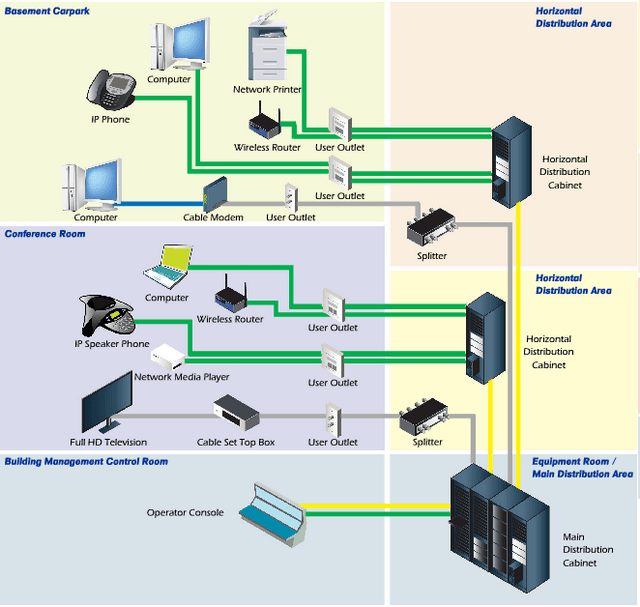
An improperly installed network can result in chaos for an entire organization as it expands. In contrast, a well-designed structured cabling system allows a network to function smoothly even when it is growing rapidly.
During this period of increasingly sophisticated technology, structured cabling is the right answer for building an efficient and cost-effective network. There are numerous companies around the world that specialize in installing structured cabling, but finding the right team for your company will require due diligence.
Many companies undergoing growth focus on revamping existing structured cabling to ensure an uninterrupted flow of an increasing volume of communications and data. They hire a team of specialists who provide guidance on the cabling that will be ideal for their new infrastructure.
Designing and planning a new network revolves around implementing structured cabling solutions that will help a company meet its business needs. There are a handful of basic guidelines for the installation as summarized below:
- Ethernet cable for office buildings, data centers, call centers, small offices, and warehouses
- Fiber cable, multi-mode and single mode, for long distance calls and interactions that are free of interference
- Telco-level network wiring, patch panels, and jacks
In the case of a small office, a brand new space yet to be wired, an existing site undergoing remodeling, or a skyscraper filled with office suites, installing well-designed structured cabling that ensures an efficient and expandable network, is the key to success for the great majority of businesses. Properly installed structured cabling helps ensure the rapid and continuous flow of data, the most valuable asset of a modern company.
Progressive Office Cabling
Founded in 1986, Progressive Office’s success has been a direct result of years of commitment to seeking solutions on behalf of our clients in the Washington, D.C. and New York City areas. Efficiently working together, Progressive teams get cabling installed and operating as fast as possible while minimizing disruption and downtime. Call our toll free number (800) 614-4560 today.

Network Design Principles – Part 2
Reliable & Manageable Scaling
Scalability is a crucial characteristic that must be considered by network designers.

In addition, a network should also be reliable and manageable, which promote stability. A network may be capable of expanding to several thousand routers. However, if there is a failure of some sort that causes instability due to greater processing and CPU usage required to compensate, the design won’t be successful.
A scalable network that is a challenge to manage or troubleshoot is also unacceptable.
Network problems that arise would take an excessive amount of time to address and repair, negatively impacting an organization’s business goals of the organization.
Thus, a scalable design must provide a manageable and reliable network.
Combining scalability, reliability, and manageability as the qualities of a network is a challenge. As a network expands, it becomes more complex, making management, maintenance, and repair more difficult.
Fault Isolation & Simplicity
Providing fault isolation boundaries creates fail-stop behavior for the wanted fault model. Fail-stop prevents faulty behavior from propagating past a fault isolation boundary. Effective network design must prevent a failure in one domain from spreading to other domains within a network. This is essential for the avoidance of unneeded processing and delays throughout the whole network because of a device or link failure. In addition, this will result in a converging network that has more stability, reliability, and speed.
The above concept also promotes simplicity as a network architecture characteristic, which decreases complexity in operations. Typically, fault isolation stops the propagation of network fault information across several domains or network areas. This will lead to greater network stability and the minimization of recovery time after failures.
The negative consequences due to a failure of a link or network node may spread to all devices across a network, resulting in a large volume of unneeded processing. A properly designed network using the Fault Domains Principle with its logical separation will limit the negative impact to within one fault domain.
Progressive Office Cabling
Founded in 1986, Progressive Office’s success has been a direct result of years of commitment to seeking solutions on behalf of our clients in the Washington, D.C. and New York City areas. Efficiently working together, Progressive teams get cabling installed and operating as fast as possible while minimizing disruption and downtime. Call our toll free number (800) 614-4560 today.

How Improper Cabling Causes Network Issues – Part 1
Your employees are dissatisfied by their company’s network performance, and it is affecting their productivity. A number of factors must be taken into consideration. How many users are attempting to use resources simultaneously? Have you taken into account how much the use of devices has grown? Is your network equipment sufficient to meet demand? Answering the above questions will help, but network issues may be directly related to your company’s structured cabling.
Outdated Cabling
In many instances, the age of your structured cabling system may be responsible for poor network performance. 15-year-old cabling may have met standards when it was installed, but now it may be unable to handle the ever increasing network traffic needs of your company.
An internet service provider (ISP) provides the cable that provides the connection from your company’s network to the internet. When this backbone component fails to meet today’s bandwidth standards, bottlenecks may occur.
In situations where you are attempting to operate at speeds that are too high or carry excessive bandwidth via a cable that not rated for the capacity, it will be noticeable to users and their productivity will decline, hampering business operations.
Quality of Cabling
Cabling manufacturers rate their cables in terms of capability and performance. For example, CAT6 and CAT6a cabling have different capabilities, CAT being an abbreviation for category. A manufacturer must meet the performance standards set by the Telecommunications Industry Association (TIA) for each category of cabling.
Cabling that exceeds minimum standards will attain higher network speeds without having to upgrade your cabling. In contrast, for cabling that only meets the minimum standards, the company network speed will be unable to expand much beyond the rating of the cable.
It is helpful to understand cable standards and ratings. Even though a cable is labeled Category 6A, it is not automatic that it meets the minimum performance standards of this category. The brand name and manufacturing quality will play a big role in the cable’s output.
Part 2 will discuss Compatibility, Patch Cords, and Poor Installation.
Progressive Office Cabling
Founded in 1986, Progressive Office’s success has been a direct result of years of commitment to seeking solutions on behalf of our clients in the Washington, D.C., Atlanta, Pittsburgh and New York City areas. Efficiently working together, Progressive teams get cabling installed and operating as fast as possible while minimizing disruption and downtime. Call our toll free number (800) 614-4560 today.
;