cat6-cabling,data cabling,

Shielded or Unshielded Cat6 cable?

22 Feb 2013

cat6-cabling,data cabling,With high bandwidth applications and network systems venturing into factory environments, the need for shielded Cat 6 cable has increased. In these new areas of installation, the environment where the network cable is run has large amounts of EMI (Electro-Magnetic Interference). Although Cat 6 cables have improved cable twist to reject noise and handle gigabit Ethernet this by itself is not enough for high EMI environments. A shielded Cat 6 cable helps in high EMI installations. These high performance cables ensure the data within the cable will be protected from EMI, resulting in higher speeds and better data transmission.


Grounding Necessities for Shielded Cat 6 cables

Shielding helps protect the data from electromagnetic interference from outside sources that  could alter or weaken the signal traveling through the copper in the cable. The shields of the two connectors are electrically tied together by the drain wire. However, they will only become grounded if the jack they are placed in has its shielding tied to ground.  If you are setting up a network with Category 6 shielded cables, you should use Cat 6 shielded couplers and jacks.


Installation caveats


Category 6 and 6a cable must be properly installed and terminated to meet specifications. The cable must not be kinked or bent too tightly (the bend radius should be at least four times the outer diameter of the cable). The wire pairs must not be untwisted and the outer jacket must not be stripped back more than 1/2 inch (1.27 cm).


All shielded cables must be grounded for safety and effectiveness and a continuous shield connection maintained from end to end. Ground loops develop when there is more than one ground connection and the difference in common mode voltage potential at these ground connections introduces noise into the cabling.

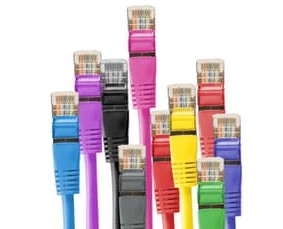
network cabling,Cat6a Cabling in Atlanta

All About Cat6a Cable

11 Feb 2013

Cat6a Cabling in AtlantaIt was once thought that copper cabling would never support speeds above 1 Gig, but Augmented Category 6, or Cat6a - has proven that wrong. Copper still lives and copper cabling may still be around at 40 Gig.


There has been much debate about which is the better option for supporting 10 Gig: Cat6a Unshielded Twisted Pair (UTP)  or Cat6a Shielded Twisted Pair (STP)?  Both solutions have their uses, and some key information can help installers make informed decisions.


Standards and Alien Crosstalk


The IEEE released the 802.3an 10GBASE-T standard in June of 2006, which specifies 10Gbs data transmission over four-pair copper cabling. The Telecommunications Industry Association (TIA) then began work on transmission performance specifications for the cabling. They published TIA Standard 568-B.2-10: Transmission Performance Specifications for 4-Pair 100 Ohm Augmented Category 6 Cabling in February 2008.


The new Cat6a standard extends the frequency of Cat6a cables to 500 MHz with specifications for a new performance parameter called Alien Crosstalk (ANEXT). Cat6a cables are fully backward compatible with all previous categories, including Cat6 and 5e. NEXT is crosstalk that occurs between adjacent cables and connecting hardware. The higher frequency signals of Cat6a makes ANEXT the limiting noise source for Cat6 and Cat5e systems.


Cat6a UTP vs. STP


Due to its ease of installation and familiarity among installers, Cat 6A UTP is today’s cabling of choice as it can support future bandwidth needs and 10Gb/s performance. In addition, the shield n the STP cable helps prevents electromagnetic and radiofrequency interference (EMI/RFI) on twisted pairs, helping eliminate the effects of noise from sources like machinery, generators, or medical imaging equipment, making STP systems the  choice for industrial and healthcare facilities.


As most residential systems are not faced with EMI/RFI challenges, so UTP is still the recommended cabling type for home installations.

Data Cabling, Cat5e Cat6/6a Cabling, Washington DC

Cat6 Q&A

4 Feb 2013

Data Cabling ,Cat5e ,Cat6/6a CablingWhat is Cat6? Cat6 components are interoperable between different vendors and are fully backward compatible. Cat6 has the same nominal Impedance of 100 Ohms as Cat5 and 5e components, but with tighter tolerance on Impedance variations. Transmission parameters are specified to 250 MHz, compared to 100 MHz for Cat 5/5e.


Do Cat6 components behave differently?   The diameters of Cat6 cables range between 0.21 to 0.25 inch (5.3 - 5.8 mm) compared to Cat5/5e’s range of 0.19 to 0.22 inch (4.8 – 5.5 mm).   Cat6 also has a tighter twist length to reduce crosstalk interference.


What about installation?  Cat6 cables and components are installed similar to Cat5/5e. There are design and installation issues that contractors and installers must pay greater attention to; including cable terminations and the pathway fill.


Will Cat6 supersede Cat5/5e?  Yes. The only question is when. The installed cost for Cat6 cabling can be about 20 % higher than Cat5e, but prices will decrease as usage increases.


Will Cat6 deliver what is promised?  Yes. There are no technical obstacles. Test parameters and procedures to qualify Cat6 components to ensure interoperability between different vendor’s products are in place and detailed.


What about the installed performance compared with Cat5/5e?  The biggest benefit is much-improved Signal-to-Noise Ratio at the Receiver:  Cat6 provides about 16 times better Signal-to-Noise Ratio compared to Cat5/5e over a wide frequency range.


Why do we need Cat6? The real question is “is Cat5e good enough for today and in the foreseeable future?”  The answer is “Yes, but…”. Network switch ports are often at the “marginally compliant” limits of the IEEE standard and susceptible to cabling and temperature variations. Cat6 provides fewer bit errors than Category 5e for 100BASE-TX and 1000BASE-T applications.