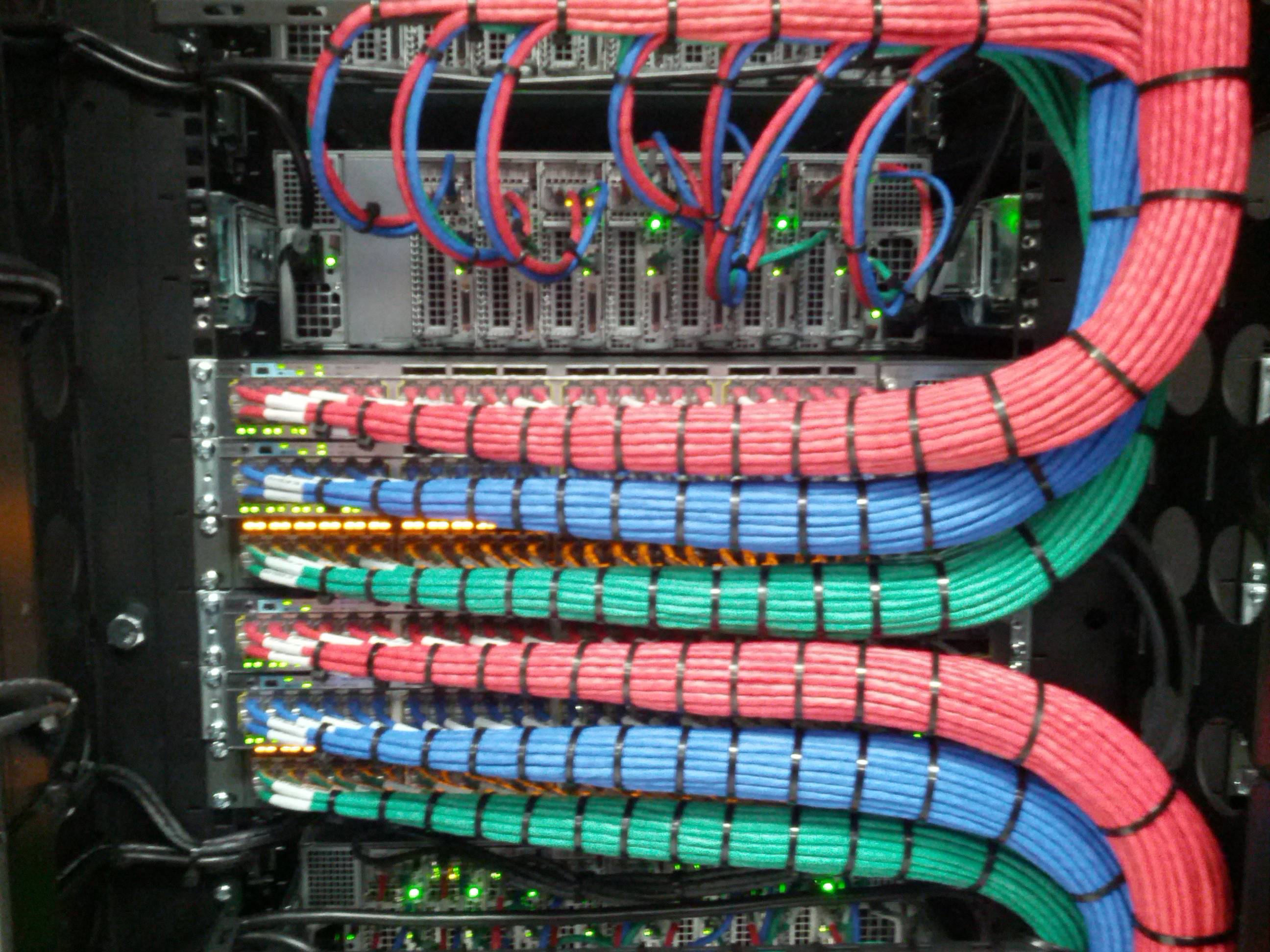
structured cable management

Structured Cabling’s Six Subsystems – Part 2

28 Aug 2017

structured cable management,DCAs mentioned in Part 1, a structured cabling system is a type of open network structure that can be used by data, telephony, access control, building automation, and other systems. Its advantages are operational flexibility and economy. Part 2 will describe each of structured cabling's six subsystems below.


The Six Subsystems


1. Entrance Facilities


Entrance facilities house the protection devices, network demarcation points, cables,  connecting hardware, and other equipment that connect to private network cabling or the access provider. Connections between the inside building and outside plant cabling are included.


2. Equipment Room


Featuring environment control, the centralized area for telecommunications equipment is typically more complex than a telecommunications room. Usually containing the main cross-connect, it may also house the horizontal and intermediate cross-connects.


3. Backbone Cabling


Backbone cabling provides the interconnections between entrance facilities, telecommunications rooms, equipment rooms, etc. Typically, backbone cabling is comprised of fiber optic cables, intermediate and main cross-connects, mechanical terminations, and patch cables utilized for backbone-to-backbone cross-connections.


4. Telecommunications Room


Housing the terminations of backbone and horizontal cables to connecting hardware with patch cords or jumpers, a telecommunications room may also house the intermediate cross connects or main cross connect for different portions of the backbone cabling system. This space is a controlled environment containing telecommunications equipment, connecting hardware, and splice closures.


5. Horizontal Cabling


Extending from the work area’s telecommunications information outlet to the telecommunications room, the horizontal Network Cabling consists of horizontal cables and mechanical terminations, along with the jumpers and patch cords located in the telecommunications room. The system may also incorporate consolidation points and multi-user telecommunications outlet assemblies.


6. Work Area


The work area’s components typically extend from the telecommunications outlet/connector end of the horizontal cabling system to the work area equipment. At least two telecommunications outlets should be installed in every work area. If utilized, multi-user telecommunications outlet assemblies (MUTOAs) are a component of the work area.


Progressive Office Cabling


Founded in 1986, Progressive Office’s success has been a direct result of years of commitment to seeking solutions on behalf of their clients in the Washington, D.C. and New York City areas. Working together, their cabling teams get cabling installed and operating as fast as possible while minimizing disruption and downtime. Call their toll free number (800) 614-4560 today.
Structured cabling,Network Cabling, Washinton DC

Structured Cabling’s Six Subsystems – Part 1

22 Aug 2017

cable management,Network Cabling,Washinton DcA structured cabling system is a type of open network structure utilized by data, telephony, access control, building automation, and other systems. Its advantages are operational flexibility and economy. A structured cabling system is typically divided into these six subsystems: 1) Entrance Facilities, 2) Equipment Room, 3) Backbone Cabling, 4) Telecommunications Room, 5) Horizontal Cabling, and 6) Work Area.


Overview


Structured cabling is the design and installation of a cabling system that can provide support to several hardware use systems, and be suitable for both the needs of the present and the future.


Governed by international standards regarding the wiring of data centers, offices, and apartment buildings for data or voice communications, structured cabling design and installation utilizes several types of cable. These are typically CAT5e and CAT6, along with fiber optic cabling and modular connectors.


Defining methods and specifications for the laying of cabling in various topologies for meeting customer needs, standards typically require the use of a rack-mounted central patch panel from which modular connections can be used as required. Every outlet is then patched into a network switch for network usage or into a PBX (private branch exchange) or IP telephone system patch panel.


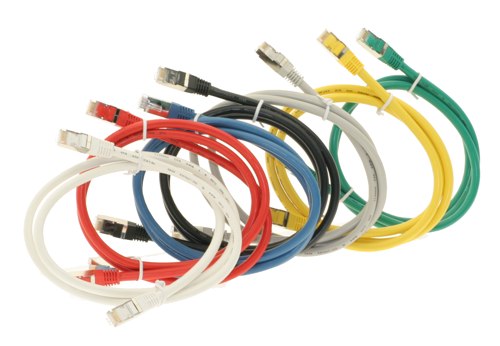
The use of color code patch panel cables is common for identifying the type of connection. However, it is not required by structured cabling standards with the exception of the demarcation wall field.


Cabling standards require that all eight conductors of CAT5e, CAT6, and CAT6A cable are connected to discourage "doubling-up" or the use of one cable for both data and voice. However, IP telephone systems are capable of running both telephone and the computer on the same wire.


When copper cabling, CAT5e, CAT6, or CAT6A is used, the maximum distance is 90 meters (98 yards) for the permanent link installation, along with an allowance of 10 meters (11 yards) for patch cords at the combined ends. Both CAT5e and CAT6 are capable of running Power over Ethernet (PoE) applications up to 90 meters. Due to power dissipation, CAT6A performs better and more efficiently.


Part 2 will summarize each of structured cabling's six subsystems.


Progressive Office Cabling


Founded in 1986, Progressive Office’s success has been a direct result of years of commitment to seeking solutions on behalf of their clients in the Washington, D.C. and New York City areas. Working together, their cabling teams get cabling installed and operating as fast as possible while minimizing disruption and downtime. Call their toll free number (800) 614-4560 today.

Network Cabling ,Data Cabling, Fiber-optic cable,New York City

Modern Cabling System Design Trends – Part 2

17 Aug 2017

Office Cabling,New York CityAs discussed by Part 1, the most significant trend in IT (information technology) is the greater reliance of organizations on high-performance data communications (datacom) cabling. Part 2 will cover High Performance Cabling and Aesthetics of Cabling.


High Performance Cabling


The use of high performance cabling of copper and fiber optic cabling is influencing the design of wiring and cabling management systems. Data transmission integrity must be maintained by cable bend radius specifications. Now available are specialized fittings for raceways and other management systems that ensure minimum cable bend radius, preventing damage and maintaining effectiveness. Upcoming technologies such as 10 G/s Ethernet will result in greater demands, making it even more important that every aspect of a structured cabling system ensures high performance.


Being able to provide adequate space for the accommodation of bend radius needs to work in conjunction with the goal of being unobtrusive visually. This objective is affected by the necessity of physically separating power and low-voltage channels to prevent EFT (electrical fast transient) disturbances. Fortunately, a new raceway design maintains complete separation through crossover fittings that provide more space inside the raceway, allowing the bend radius of 10G/s cable’s larger diameter.


Aesthetics of Cabling


The design of modern wiring and cable management systems now aspire to both form and function. Non-metallic raceways with visually attractive profiles in a variety of colors are now available in the marketplace. Stainless steel is also trending, featuring plates that conceal seams. Moreover, components can be combined in matching colors and styles. This ongoing aesthetic drive has led to almost invisible activations that are recessed and flush. Poke-through devices now feature datacom ports and receptacles with sleeker profiles. Accommodating a greater number of outlets, high-capacity service activations are much less obvious than dated low-capacity fittings.


Summary


Product development for wiring and cabling management systems must unceasingly keep pace with increasingly complex datacom requirements. Solutions from manufacturers must be compatible with a wide variety of datacom cabling, allow for both system and operational flexibility, and deliver eye-pleasing aesthetics in the workplace.


Progressive Office Cabling


Founded in 1986, Progressive Office’s success has been a direct result of years of commitment to seeking solutions on behalf of their clients in the Washington, D.C. and New York City areas. Working together, their cabling teams get cabling installed and operating as fast as possible while minimizing disruption and downtime. Call their toll free number (800) 614-4560 today.

Data Cabling,Structured Cabling, Cabling Design-Washington DC

Modern Cabling System Design Trends – Part 1

5 Aug 2017

 Data Cabling,Structured Cabling,Washington DC The most significant trend in IT (information technology) is the greater reliance of organizations on high-performance data communications (datacom) cabling. Industry leaders are reporting more than 50% of their market is for data and communications applications. Consequently, their research and development is concentrating on the development of new products and system enhancements.


Objectives of System Design


IT is accelerating rapidly, and people are using it in ways and in areas that only became possible recently. Modern system design aims for maximizing communications capability and flexibility even in limited spaces that emphasize openness and visibility. As a result, the connections between workstations and datacom networks have grown in importance.


Various cable and wire management systems can be used for the management, organization, protection, and connection of cabling infrastructure. These systems allow communication, collaboration, and the flexibility to adapt to the evolving needs of businesses and their workspaces. Five systems are discussed below.


Open Space


Precisely positioned within an open space to allow power and datacom feeds into modular office furniture, poke-through devices can feature audio, video, and control connectors, along with active modules.


Overhead


Flexible and allowing accessibility in drop and open-ceiling applications, overhead systems utilize cable trays that are available in various styles, such as center spine, wire mesh, ladder, and solid bottom.


Perimeter


Easily accessible, expandable, and configurable, perimeter systems are capable of securely routing wiring and cabling along walls. They are primarily used for offices, classrooms, training centers, and conference rooms, offices, classrooms, and training centers.


Tabletop Modular Outlet (TMO)


TMO centers allow easy accessibility to datacom and power on task tables, desktops, study carrels, and lecterns. Their two main styles are recessed and pop-up, linking networked and portable computing.


Vertical Distribution


Visually attractive, vertical distribution units deliver datacom and power from ceilings directly to workstations. Absent the clutter of service poles, they conceal wiring and cabling in an aesthetically pleasing way.


Part 2 will cover High Performance Cabling and Aesthetics of Cabling.


Progressive Office Cabling


Founded in 1986, Progressive Office’s success has been a direct result of years of commitment to seeking solutions on behalf of their clients in the Washington, D.C. and New York City areas. Working together, their cabling teams get cabling installed and operating as fast as possible while minimizing disruption and downtime. Call their toll free number (800) 614-4560 today.