Data Cabling Network Office Cabling NYC

Three Basics for Server Room Network Cabling Management
30 Dec 2018

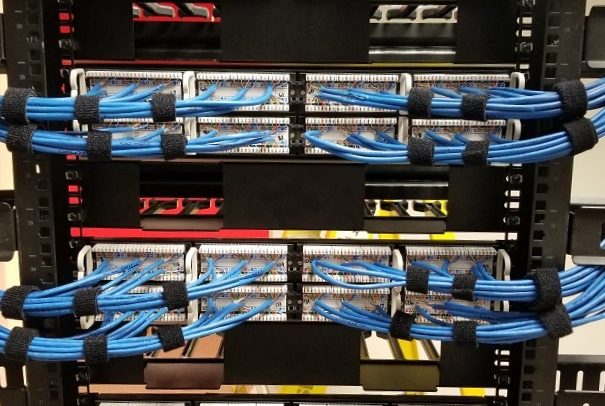
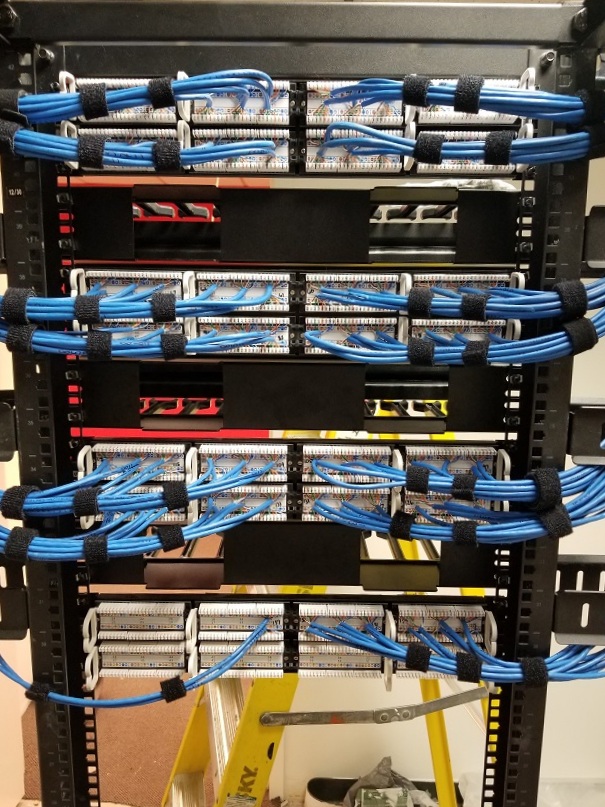
Data Cabling Network Office Cabling NYCDisorganized cabling in the server room does not reflect well on your company. It happens to be also a safety hazard. Below are three basics for server room cabling management that will keep things tidy.


  1. Dispose of Unused & Damaged Cables
    There may be bundles of ancient cables in your server room that were used for equipment that no longer exists or was replaced months or years ago. If cables are no longer needed, dispose of them. These outdated cables will clutter the workspace and make it difficult to make necessary changes or replacements.Due to storage limitations, cabling was piled on top of each other. After an extended amount of time this will damage cables at the bottom because of the weight. Crushed cables will result in signal degradation.

  2. Labeling System
    The cabling in a server room will often undergo revisions, replacement, and transfer. Imagine you are a new IT staff member who is walking inside for the very first time and you have to trace a particular cable to a specific device.To save time and money, use a simple labeling system for your server room. As part of the best practices of structured cabling, each end of a cord should be labeled, no matter how short. This will ease the process of identification.IT staff can utilize color-coded labels to indicate the various kinds of equipment. For example, servers can have red labels, while routers use blue. A labeling system helps minimize downtime, saving money, because technicians can swiftly determine and replace the problem cable.

  3. Minimize Long Cables
    Excessively long cables can be a safety hazard due to the possibility of IT staff tripping over them inside a server room. Technicians should identify which of the cables are too long. Each should then be replaced by a cable of proper length or shortened. There are also commercial solutions for organizing long cables so they are much less intrusive.


Progressive Office Cabling


Founded in 1986, Progressive Office’s success has been a direct result of years of commitment to seeking solutions on behalf of our clients. Efficiently working together, Progressive teams get cabling installed and operating as fast as possible while minimizing disruption and downtime. Call our toll free number (800) 614-4560 today.
Washington DC Cat6 Fiber Office Cabling

How to Optimize your Company’s Data Center – Part 2

22 Dec 2018

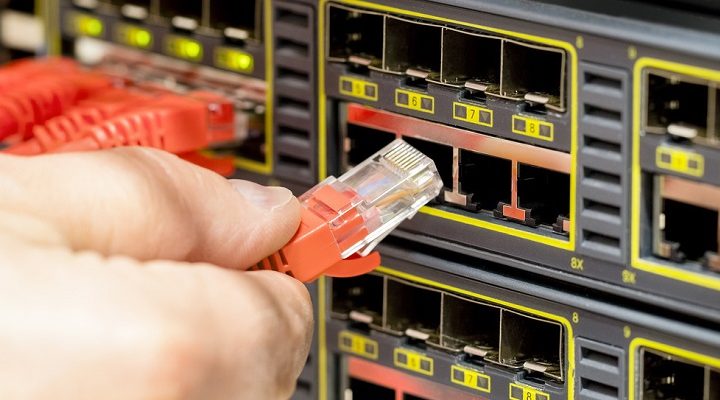
Fiber Cabling Company DC Pittsburgh PA Atlanta GAAs discussed in Part 1, companies that process significant volumes of data are constantly searching for methods that will maximize their existing data centers. Part 2 will cover Physical-Layer Management and Transitioning to Optimized Infrastructure.


Physical-Layer Management


Data centers can also optimize their operations by employing physical-layer management for cabling, patch panels, and fiber frames. Physical-layer management revolves around the utilization of cabling with intelligent patch panels, fiber frames, and patch cords for registering the connection state and type of each circuit and updating database records.


A physical-layer management system deploys an embedded chip on every patch cord which interfaces with managed patch panels or fiber frames. These chips transmit data about the connecting components, including the unique ID number for every cable assembly and component, performance ratings, assembly lengths, cable colors, polarity, part numbers, and manufacturer locations and dates. Upon connecting a patch cord, the physical-layer management system begins transmitting and documenting to advise the operator regarding the connected equipment.


Physical-layer management systems are capable of working independently or integrating via middleware with other network-management systems or data center infrastructure management (DCIM). As a result, the network management team will not be required to become familiar with a new interface or tool for managing the data center.


Transitioning to Optimized Infrastructure


Deciding on what needs to be upgraded and when to do so are critical steps. As previously mentioned, standardizing infrastructure and implementing physical-layer management will be required for full optimization. However, the process can be accomplished in incremental stages. Perhaps standardization can commence one component at a time as determined by the resources available to an organization.


The expansion or construction of a data center must be considered by management in light of its remaining capacity. Tools that measure the performances of standardized infrastructure and physical-layer management will allow technicians to accurately evaluate current capabilities and assess how much optimization is possible.


Progressive Office Cabling


Founded in 1986, Progressive Office’s success has been a direct result of years of commitment to seeking solutions on behalf of our clients in the Washington, D.C. and New York City areas. Efficiently working together, Progressive teams get cabling installed and operating as fast as possible while minimizing disruption and downtime. Call our toll free number (800) 614-4560 today.

Office Cat6 Cabling Pittsburgh PA

How to Optimize Your Company’s Data Center – Part 1

12 Dec 2018

Office Cat6 Cabling Pittsburgh PACompanies that process significant volumes of data are constantly searching for methods that will maximize their existing data centers. User demand is projected to increase rapidly due to the booming growth of video and mobile device usage for business. Optimization can be accomplished through a number of methods.


Virtualization


Virtualization optimizes server and switching infrastructure through the placement of frequently used servers and switches in the same location. The placement of cooling resources there will also increase cooling efficiency and conserve power. Other methods that minimize costs involve co-location and cloud storage.


Passive Infrastructure Standardization


Perhaps underutilized for data center optimization is passive infrastructure standardization. Passive infrastructure is comprised of the products needed to support a data center’s active equipment. This includes copper and fiber cabling, cabinets, racks, and pathway solutions. Structured cable management is crucial for standardizing passive infrastructure, so technicians must properly route patch and trunk cables. Below are four aspects of employing standardized passive infrastructure.


Fiber – When considering fiber structured cabling, management must decide whether to select single-mode or multimode fiber. Less costly, multimode fiber is ideal for shorter runs, such as those between racks in the same row or within the same rack. However, for longer runs spanning mega data centers or between several data centers, the preferred practice is using single-mode fiber.


Operations – In constant flux, data centers frequently undergo changes, additions, and moves. Technicians who perform tasks with standardized infrastructure can finish their tasks faster and with less effort. Moreover, a standardized infrastructure will be less costly.


Reliability – Standardized infrastructure with proper cable management reduces the potential for bent or broken fibers because there’s a proper place for every cable.


Cooling Costs – Using the correct diameter cabling will often increase airflow surrounding active equipment. Smaller diameters will decrease cooling and energy costs, with cooling costs representing the greatest expense in running a data center.


Part 2 will discuss Physical-Layer Management and Transitioning to Optimized Infrastructure.


Progressive Office Cabling


Founded in 1986, Progressive Office’s success has been a direct result of years of commitment to seeking solutions on behalf of our client. Efficiently working together, Progressive teams get cabling installed and operating as fast as possible while minimizing disruption and downtime. Call our toll free number (800) 614-4560 today.

Network Switch Cabling Company Atlanta GA

10 Trending Reasons for Upgrading Network Cabling

8 Dec 2018

Network Switch Cabling Company Atlanta GAExpert professional providers of network cabling are attuned to the current trends regarding the needs of their customers. They have noted that their clients are becoming increasingly motivated to upgrade network cabling because of the rapid growth of data and its business usage. The following is a list of their 10 trending reasons for upgrading network cabling in 2019.


  1. Access Control & Time and Attendance – Increasingly, these two systems are network connected. The ability to monitor people on premises from a central location enhances safety and security.

  2. CCTV Upgrades – IP CCTV systems are becoming the standard, and are connected to a network to allow both internal and external communications.

  3. Consolidation – Transferring staff or networked machinery from several facilities to one location may require more network outlets.

  4. Display Screens – Efficiently distributing informational video to staff, clients, customers, and partners will mean display screens require network connectivity.

  5. Expansion – May result in a growing number of employees or networked machinery, requiring more network outlets.

  6. Inventory Control – Stock management is usually performed with barcode scanners connected to servers via Wi-Fi. Thus, wireless access points require connectivity to network outlets.

  7. Reliability & Performance Problems – Improper installation of existing cabling systems may require a comprehensive network upgrade supported by documentation or certification to cope with the exponential growth of data and to remain competitive.

  8. SIP Phone System Upgrade – More network outlets are usually necessary to provide connectivity to the new phones. Frequently, savings from the SIP installation can cover the infrastructure upgrade costs.

  9. Tooling & Machinery Upgrades – New plant equipment will typically be “smart” and require network connectivity, which may require more network outlets in close proximity.

  10. Wi-Fi Upgrade – The rapid growth of wireless devices for business use will require faster Wi-Fi with improved coverage. More wireless access points will be necessary.


Progressive Office Cabling


Founded in 1986, Progressive Office’s success has been a direct result of years of commitment to seeking solutions on behalf of our clients in the Washington, D.C. and New York City areas. Efficiently working together, Progressive teams get cabling installed and operating as fast as possible while minimizing disruption and downtime. Call our toll free number (800) 614-4560 today.