Planning – Network Design Requirements
After receiving the requirements for a network, it is common for designers to prioritize their implementation and integrate them into the format of the design. Occasionally, they initially rely on best practices, instead of focusing on planning. This is unfortunate because the planning process often leads to discovering multiple viable design solutions.
Designers should first make business-centric decisions determining either the solution or design that supports the company’s objectives or strategy. Although it is advisable to follow best practices for network design, reliance on them is more typical on occasions when a network is being designed from the ground up, which is usually not the case for large service providers and enterprises.
Let’s consider optimizing office buildings as a comparison. The standard procedure for civil engineers and architects is to perform an evaluation of a building by identifying existing problems, understanding the organization’s goals, and gathering business requirements. Afterwards, they begin optimizing the office building’s existing features. As examples, this may involve replacing the elevators or expanding the lobby.
The above is similar to the procedure for revamping network design. There will always be faulty designs that were poorly planned. Sometimes they are unable to scale, or adopt emerging technologies, or adapt to changing business conditions. Thus, designers must first make a comprehensive study of the existing business problems, IT requirements, and network design. Next, they should develop solutions that will optimize the present architecture. This may entail redesigning several components of the network. It can also require the addition of a new data center.
In order to choose the correct design choices and technologies, network designers must gather the necessary information that will allow them to make a sound analysis during the planning stage. This also lets them correctly determine the new requirements that will support the company’s business goals. At this point, network designers typically utilize the decision tree and the decision matrix for easing and simplifying the process.
Progressive Office Cabling
Founded in 1986, Progressive Office’s success has been a direct result of years of commitment to seeking solutions on behalf of our clients in the Washington, D.C. and New York City areas. Efficiently working together, Progressive teams get cabling installed and operating as fast as possible while minimizing disruption and downtime. Call our toll free number (800) 614-4560 today.


Typical Installation Mistakes of Network Cabling – Part 2
As discussed in Part 1, network cabling installation errors may result in long-term problems and high costs. They can be avoided by following standard structured cabling practices. Continuing with the discussion of typical network cabling installation mistakes, Part 2 will cover Ignoring Regulations, No Testing, and Skimping On Labor.
Ignoring Regulations
There are codes, laws, and ordinances that regulate low voltage cabling, and they vary, depending on the municipality, city, and state. Experienced professionals who install network cabling are knowledgeable about the applicable requirements and how to complete a project to code. When the fire marshal or building inspector determines laws were broken or wiring is not up to code, a company can be penalized with large fines and required to remove and reinstall cabling if it is a fire hazard.
No Testing
When network cabling is installed, each cable should undergo testing. This should also involve the verification of a cable’s length and specifications. This process is crucial because it will confirm whether or not the network satisfies project specifications. The data also provides a basis for future testing and troubleshooting, along with supporting any warranty claims.
Skimping On Labor
Considering how important the network cabling installation is to the future, cutting corners in the hiring of cabling installers is unwise. It is crucial to always verify the qualifications and licensing of the cabling installation company you are considering. Make the time and effort to check each reference that is provided. This may save your company time, money, and problems if you avoid working with an outfit that provides substandard services support. Request the contact information of previous customers who had projects similar to yours and get their opinions before making a commitment. Finding an installer that is the right fit for your project is the first step for ensuring a successful network cabling installation.
Progressive Office Cabling
Founded in 1986, Progressive Office’s success has been a direct result of years of commitment to seeking solutions on behalf of our clients in the Washington, D.C. and New York City areas. Efficiently working together, Progressive teams get cabling installed and operating as fast as possible while minimizing disruption and downtime. Call our toll free number (800) 614-4560 today.

Constraints of Network Design
The constraints of network design are existing factors that cannot be altered, often impacting architecture and functional requirements. These constraints can have a significant effect on network design and must be taken into account. Below are the most familiar design constraints that must be addressed by a network designer.
Cost
Cost is certainly a limiting factor that must always be considered during the design process.
Experienced & Expensive Staff
In order to quickly adapt to new technology, a company may decide to hire technical employees who are expert in the new technologies, but cost more in salary. The greater operational costs for their expertise may exceed the benefits from the decreased TCO (total cost of ownership) derived from the latest technology.
Expertise of Staff
It may be the case that the most efficient, cost-saving design with state-of-the-art technology was presented by the network design team. However, the current staff may not have the experience or know-how to implement this new technology.
Infrastructure Equipment
In cases where an organization has not planned how to replace legacy network devices, the situation can lead to severe limitations on network design. This is quite apparent when new protocols and features cannot be supported.
Location
This is a difficult kind of constraint because location involves limitations that have an indirect effect on design. To illustrate, a rural site might be in a region where fiber infrastructure is not present and wireless is the only connectivity.
Staff Training
Due to the lack of experience of technical staff in a newer technology, issues may take longer to detect and repair until they are adequately trained. This will lead to longer downtimes that render a data center nonfunctional, resulting in business losses.
Time
When choosing an architecture or technology, time becomes a constraint when the time frame plays a part in remaining on schedule for the completion of the project.
Progressive Office Cabling
Founded in 1986, Progressive Office’s success has been a direct result of years of commitment to seeking solutions on behalf of our clients in the Washington, D.C. and New York City areas. Efficiently working together, Progressive teams get cabling installed and operating as fast as possible while minimizing disruption and downtime. Call our toll free number (800) 614-4560 today.

Creating the Requirements of Network Design
Various requirements that are skillfully combined during the implementation phase can result in a desired network design that helps attain a company’s business goals. Below is a classification of requirements for an organization. Some may be directly provided by the network design team while others may be determined from the goals or requirements of the company.
Business Goals
- Decreasing operational costs
- Expanding business via additional remote sites
- Increasing staff productivity
Business Requirements
- Decrease expenses for the maintenance of multiple voice & data networks
- Provide support for expanding business via additional remote sites
- Raise staff productivity by improving internal communications via mobile and video devices, while safeguarding company security
Functional Requirements
- Ability to introduce and support new remote sites to the network without redesign
- Infrastructure supporting data, video, voice, and wireless in a unified manner
- Isolation of guest and employee wired and wireless traffic to comply with standard company security policy
Application Requirements
When an organization plans to add video and VoIP capability to their network, particular application requirements must be met. In such instances, the network design must be capable of providing sufficient network availability, efficiency, and performance for these two new features to support business goals.
Technical Requirements
In order to attain the above example’s functional and application requirements in consideration of the company’s business goals, the network design must have the following features:
High Availability – Raise the level of high availability in order to support traffic crucial to business, such as data and voice.
Quality of Service (QoS) – User experience can be greatly improved through the introduction of QoS in order to attain excellent voice and video services.
Scalability – Implement scalable network (WAN) design for supporting growth of business projected for the coming 12 months.
Security – Network security must be optimized when new features such as voice and Wi-Fi security are added.
Traffic Isolation – Provide traffic isolation to meet information security requirements.
Progressive Office Cabling
Founded in 1986, Progressive Office’s success has been a direct result of years of commitment to seeking solutions on behalf of our clients in the Washington, D.C. and New York City areas. Efficiently working together, Progressive teams get cabling installed and operating as fast as possible while minimizing disruption and downtime. Call our toll free number (800) 614-4560 today.

Technical & Application Requirements of Network Design – Part 2
As discussed in Part 1, contemporary network design requires meeting the technical and application requirements of ever expanding and evolving IT and business demands.
Part 2 will continue discussing Application Requirements.
Importance of User Expectation
Networks or IT technologies that are unable to achieve a satisfactory level user expectation or QoE (quality of experience) will be considered to have failed meeting an important business goal. As a result, they will be considered a cost, rather than tools that allow a business to succeed.
A network’s design must take into account how a satisfactory level of user experience will be attained. From the point of view of a user, QoE when utilizing services and applications will determine their level of satisfaction.
The deployment of services and applications before taking into account their features and network requirements will result in a failure to achieve business goals.
To illustrate, a financial services company that wants to provide a video communication application to their customer service representatives, but fails to secure enough bandwidth, will likely frustrate their reps and displease their customers when calls are dropped or interrupted because of excessive latency. Thus, their corporate goal of differentiating themselves from their competitors will be a failure until they meet the network requirements of the application.
Evaluation of Application Requirements
Network designers should keep in mind their responses to the key questions below for the evaluation of application requirements:
- What are the application’s features and characteristics?
- What is the length of time the application needs to reset its session or state after losing connectivity?
- What is the amount of network traffic that is required by the application?
- How important is the application to the organization and what is the service level it will require to function properly?
- For its compliance with industry regulations and company security polices, will the application have separation requirements?
Progressive Office Cabling
Founded in 1986, Progressive Office’s success has been a direct result of years of commitment to seeking solutions on behalf of our clients in the Washington, D.C. and New York City areas. Efficiently working together, Progressive teams get cabling installed and operating as fast as possible while minimizing disruption and downtime. Call our toll free number (800) 614-4560 today.

Planning the Cabling for Your New Location – Part 2
As discussed in Part 1, moving often overwhelms staff, and cabling for data, power, communications, and security may not be prioritized adequately. Part 2 will discuss Health & Safety, Flexibility, Future Growth, and Structured Cabling. Consult with an experienced and expert cabling company prior to starting your project to get the best results.
Health & Safety
Consideration should be given to the health and safety of both employees and staff when planning the cabling at your new facility. Wiring that provides connections to equipment and telecommunications and power companies should not endanger the welfare of people by blocking emergency exits, ventilation ducts, and cooling systems.
Ensure that regulatory compliance for securing certain types of sensitive or personal data will be met. This will require locating data storage, servers, and equipment processing transactions properly. Their positions should be considered during the mapping process.
Flexibility
Market conditions can become very fluid, and perhaps only a brief time after moving into a new location will an organization have to make changes in its cabling. Well-designed structured cabling will ensure flexibility that allows a company to make additions and revisions in the most efficient and fastest manner possible to reallocate resources.
Future Growth
The cabling of an organization should give allowance for future expansion of its IT infrastructure. The growth of its business may require the company to seek greater bandwidth, increased communication channels, more electrical power, and additional space. Although the future of a business is often very hard to predict, it is still possible to make projections given the current market and its prospects in the coming years.
Structured Cabling
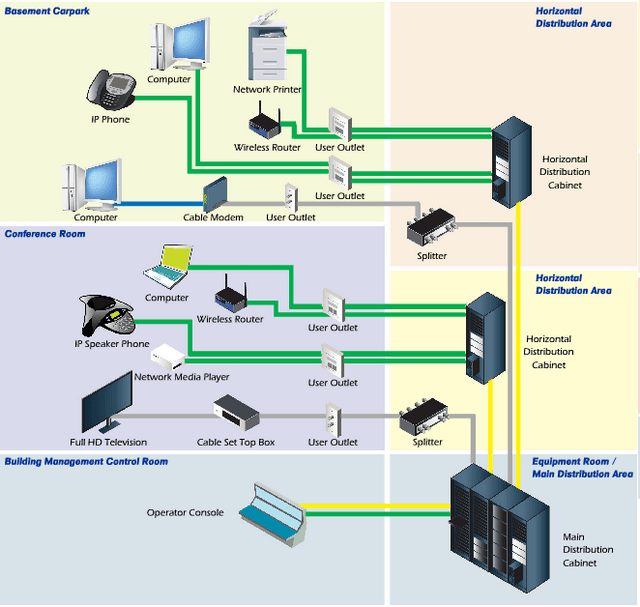
Having your data, communications, and power cabling installed by several different contractors will work against a properly configured cabling system. This haphazard approach may also result in higher management and maintenance costs. Governed by proven industry standards, a structured cabling system will provide a company an integrated IT infrastructure that allows for ease of maintenance, flexibility, and expansion.
Progressive Office Cabling
Founded in 1986, Progressive Office’s success has been a direct result of years of commitment to seeking solutions on behalf of our clients in the Washington, D.C. and New York City areas. Efficiently working together, Progressive teams get cabling installed and operating as fast as possible while minimizing disruption and downtime. Call our toll free number (800) 614-4560 today.