


Microsoft has it backwards
The myth that Microsoft has created is that the Windows operating system needs to keep getting bigger and more functional. With each new release the OS grows bigger with new applications, new graphic interface designs and new utilities. But if you take a look at the cell phone industry, you can see that the PC and the cell phone are converging.
The new cell phones from Blackberry, Apple and Plam are meant to do much more than make phone calls, send and receive messages, and browse the Web. It's a platform, like a PC, that's designed to run a wide variety of sophisticated third-party programs, or apps, from social-networking gateways to games to business tools.

Cabling Definitions
 A 19-inch rack is a standardized frame or enclosure for mounting multiple equipment modules. A frame style, open rack (see image to the right) would have outer posts but no front or side panels. An enclosed rack has sides and a door for security and usually includes ventilating fans to keep equipment cool. Enclosures are much more expensive than open racks.
Racks have a front panel that is 19 inches wide, including edges or ears that protrude on each side which allow the shelves, switches and patch panels to be fastened to the rack frame with screws.
Rack Unit or U is a unit of measure that describes the height of equipment to be mounted in a computer equipment rack. One rack unit is 1.75 inches (44.45 mm) high. The size of rack-mounted equipment is described as a number in "U". For example, one rack unit is referred to as "1U", 2 rack units as "2U" and so on. A typical full size rack is 42U, which means it holds just over 6 feet of equipment.

Wall Plates are the metal or plastic covers that house the network connection jack. Wall plates are flush-mounted on office and residential drywal surfaces.
RJ45 Connector is the modular connector that is found at the end of a network cable. It is similar in look functionality to a phone connection
 but it is larger in size and it has 4-pairs of wires rather than the 2-pairs that are found in a phone line.
Jacks and Inserts are the actual connection at the wallplate. They are often color coded to distinguish the different connections such as voice and data.
Patch Panel is a series of 24, 48 or 96 RJ45 network connectors on a
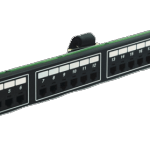
 panel. The patch panel is the hub of all incoming workstation network connections.
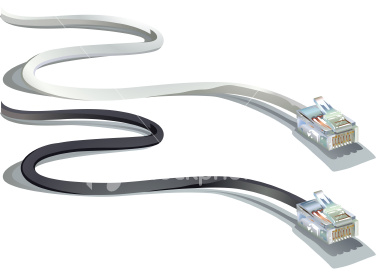
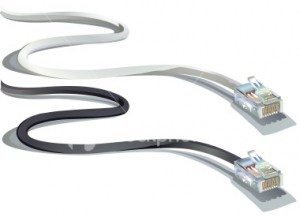
Patch Cable is a network cable with RJ45 connectors at each end that create the connection from the wallplate to the computer and also from the patch panel to the switch.
Horizontal wiring encompasses all cable from a wallplate network connection to the wiring closet. The outlets, cable, and cross-connects in the closet are all part of the horizontal wiring.
Wiring closet is an enclosed area, such as a room or cabinet, for containing network, telecommunications equipment, and cable terminations. Each building must have at least one wiring closet.

Equipment room is the space that houses the office network and telecommunications systems such as PBXs, racks, servers, and the mechanical terminations of the cabling system. Larger facilities often have Equipment Rooms rather than Wiring Closets.
Cabling administration is a process that includes all aspects of premise wiring related to documenting and managing the system, testing the system, as well as the architectural plans for the system.
Click here to go to a page that will put you in touch with us. Answer all of the questions that you can and we will get back to you with a quote.

Cat6 Cabling – Usage and Methods
Category6
 Category 6 cable, commonly referred to as Cat6, is a cable standard for Gigabit Ethernet and other network protocols that is backward compatible with the Category 5/5e standards. Cat6 features more stringent specifications for crosstalk and system noise. The cable standard provides performance of up to 250 MHz and is suitable for 100BaseTX and 1000BaseT (Gigabit) Ethernet.
The cable contains four twisted copper wire pairs, just like earlier copper cable standards. Although Cat6 is sometimes made with 23 gauge wire, this is not a requirement; the specification states the cable may be made with 22 to 24 AWG wire, so long as the cable meets the specified testing standards. When used as a patch cable, Cat6 is normally terminated with an 8P8C modular connector, commonly referred to as an "RJ-45" connector. Cat6 connectors are made to higher standards that help reduce noise caused by crosstalk and system interference.
Some Cat6 cables are too large and may be difficult to attach to RJ45 connectors without a special modular piece and are technically not standard compliant. If components of the various cable standards are intermixed, the performance of the signal path will be limited to that of the lowest category. The maximum allowed length of a Cat6 cable is 100 meters (330 ft).
 The cable is terminated in either the T568A scheme or the T568B scheme. It doesn't make any difference which is used, as they are both straight through (pin 1 to 1, pin 2 to 2, etc). Mixing T568A-terminated patch cords with T568B-terminated horizontal cables (or the reverse) does not produce pinout problems in a facility. Although it may vary slightly or sometimes degrade signal quality, this effect is marginal and certainly no greater than that produced by mixing cable brands in-channel. The T568B Scheme is by far the most widely used method of terminating patch cables.
Click here to go to a page that will put you in touch with us. Answer all of the questions that you can and we will get back to you with a quote.
Plenum Cable Definition
Space between the structural ceiling and the dropped ceiling or under a raised floor is typically considered plenum. The plenum space is typically used to house the communication cables for the building's computer and telephone network. Additionally, no high-voltage powered equipment is allowed in the plenum space because presence of fresh air can greatly increase danger of rapid flame spreading should the equipment catch on fire.
Note that diligence is required to make sure that a non-plenum airspace stays that way. A non-plenum airspace can become a plenum airspace by accident if the ductwork is disconnected and not properly repaired. Ductwork degradation can occur due to building damage such as earthquakes, aging or adverse environment causing the metal to corrode and fall apart, or simply negligence on the part of building contractors that leave work unfinished. Discovery and repair of unintended plenums is difficult due to the hidden nature, limited space, and difficult access of most installed drop ceilings. For highest fire safety it is best to assume all drop-ceiling airspaces are plenums, whether or not they are officially designated as one.Click here to go to a page that will put you in touch with us. Answer all of the questions that you can and we will get back to you with a quote.
Cable Testing and Certification
This powerful planning and certification tool tests speed and performance using the latest
 technical advances in digital measurement. It defines the job, makes the tests, prints results and stores data. Our Validator-NT measures and presents fast, clear speed and performance results up to 1 Gigabit.
And the software lets us lay out a floor plan, document and print test results plus archive jobs for future reference. It ties together all the different cable criteria found in complex voice/data/video installations. Then it presents concise information in printed reports while storing data for future use.
Cat5/5e Network Cabling Usage and Methods
Category 5
 Category 5 cable includes four twisted pairs in a single cable jacket. This use of balanced lines helps preserve a high signal-to-noise ratio despite interference from both external sources and other pairs. It is most commonly used for 100 Mbit/s office computer networks, such as 100BaseTX Ethernet, although IEEE 802.3ab defines standards for 1000BaseT - Gigabit Ethernet over category 5 cable.
Category 5e
Cat 5e cable is an enhanced version of Cat 5 that adds specifications for far end crosstalk. Although 1000BaseT was designed for use with Cat 5 cable, the tighter specifications associated with Cat 5e cable and connectors make it an excellent choice for use with 1000BaseT. Despite the stricter performance specifications, Cat 5e cable does not enable longer cable distances for Ethernet networks: cables are still limited to a maximum of 100m (328 ft) in length.
Connectors and other information
The cable exists in both stranded and solid conductor forms. The stranded form is more flexible and withstands more bending without breaking. Taking these things into account, building wiring (for example, the wiring inside the wall that connects a wall socket to a central patch panel) is solid core, while patch cables (for example, the movable cable that plugs into the wall socket on one end and a computer on the other) are stranded. Outer insulation is typically PVC or Plenum. Plenum cable is designed to go into drop ceilings that are used as air returns for the air-conditioning systems in modern office buildings.Nearly always, 8P8C modular connectors, commonly referred to as "RJ-45", are used for connecting category 5 cable.
Click here to go to a page that will put you in touch with us. Answer all of the questions that you can and we will get back to you with a quote.

Multi-tasking cell phones, the next wave
The golden age of PCs was DOS. Why? Because the OS made it very easy to write quick, powerful programs. DOS was a simple single-tasking operating system. It was easy to program on DOS because their were a lot of vendors with competing compilers that made writing applications relatively simple.
With the release of Windows, Microsoft made things much more complicated and then made it so complicated that Microsoft is now one of the ONLY company that can develop sophisticated applications on Windows. Unfortunately, Microsoft is not really very good at programming and does not need to innovate because they don't have any competition.
Optical Fiber Cabling Usage and Methods
Optical fiber is an effective medium for networking because it is flexible and can be bundled as cables. It is especially advantageous for long-distance network  communications, because light propagates through the fiber with little attenuation compared to electrical cables. This allows long distances to be spanned with few or no repeaters. Additionally, the per-channel light signals propagating in the fiber can be easily modulated at 1 Gb/s.
Fiber cable saves space in cable ducts because a single fiber can carry much more data than a single standard data cable. Fiber is also immune to electrical interference; there is no cross-talk between signals in different cables and no pickup of environmental noise. Non-armored fiber cables do not conduct electricity, which makes fiber a good solution for protecting communications equipment located in high voltage environments such as power generation facilities, or metal communication structures prone to lightning strikes. They can also be used in environments where explosive fumes are present, without danger of ignition. Wiretapping is also more difficult compared to electrical connections, and there are concentric dual core fibers that are said to be tap-proof.
Both multi-mode and single-mode fibers are used in communications, with multi-mode fiber used mostly for sho rt distances, up to 550 m (600 yards), and single-mode fiber used for longer distance links. Because of the tighter tolerances required to couple light into and between single-mode fibers (core diameter about 10 micrometers), single-mode transmitters, receivers, amplifiers and other components are generally more expensive than multi-mode components.
Click here to go to a page that will put you in touch with us. Answer all of the questions that you can and we will get back to you with a quote.
Choosing between Cat5e and Cat6 at your Office
Trends
The trend is towards higher speeds, of course. Offices have faster computers, faster Internet and more demanding applications. But does this translate into a need for Cat6 cable?
 Category 5e and Cat6 Cable
Cat 5e cable is an enhanced version of Cat 5 that adds specifications for far end crosstalk. Cat 5e cable does not enable longer cable distances for Ethernet networks: cables are still limited to a maximum of 100m (328 ft) in length. Each Cat 5e cable can carry up to 100mb/sec of data.
Cat 6 cable carries 1gb/sec of data and therefore has 10 times the data capacity of Cat 5e.
The Decision Considerations
Cat 6 will not make your Internet speeds faster. Even at fiber speeds, the Internet still only runs at a fraction of Cat 5 speeds. Cat 6 will also not make VOIP phones were better because VOIP uses only 60-90k per phone line. So, VOIP is a very unlikely reason for using Cat6 cabling
The only reason for using Cat 6 is because you are pushing a lot of data over your cable. This is true when you are running applications off of a server as in the case of a virtual PC environment where applications do not reside on the local desktop system. It is also true when you have applications that have very large data files as in CAD/CAM and other demanding graphic design systems.
A secondary, yet important, consideration is cost. Cat 6 cable is twice as expensive as Cat 5e and it also r
equires Cat 6 jacks, inserts, patch panels and switches. This can add considerably to the overall cost of a project. Any Cat 5 component will slow the connection down to 100mb.
Need more help? Click here to go to a page that will put you in touch with us. Answer all of the questions that you can and we will get back to you with a quote.