Network cabling, cables,shielding

About Ethernet Cables and Data Shielding

7 Dec 2014

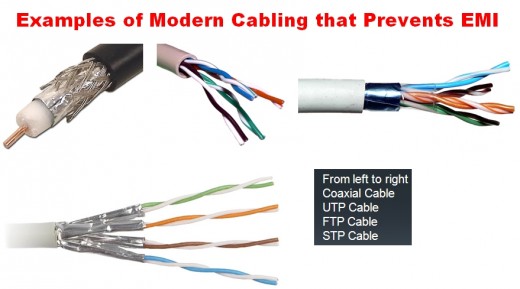
Network cabling, cables,shieldingThe Ethernet network cable connects devices on a LAN (local area network) such as personal computers, switches and routers. These cables are typically Cat5 and Cat6. These cables provide the infrastructure that connects the PCs, printers, router/modem and other peripherals to a switch. The cables are made up of stranded or solid copper wires. Stranded wires are not as susceptible to fractures but are more difficult to terminate. Solid Cat5/Cat6 also is less susceptible to electrical interference. These shielded cables are made up of braided strands of copper wrapped in a polymer layer and spiral copper tape. The shield is applied across the splices.


An Ethernet cable can be compared to an electrical power cord in that it can only extend a limited distances because of the electrical transmission properties. Meanwhile, wireless technologies (Bluetooth and Wi-Fi or local wireless technology) have enhanced the reach of Ethernet in residential and enterprise networks. The standard Ethernet cable consists of four coiled pairs that terminate at the eight pins of the clipped connector or "RJ45" at both ends of  a cable. At the wallplate is simply the female end of the same connector. The cable is made up of unshielded (UTP) or shielded twisted-pair (STP) cabling.


Shielding is not selected automatically during installations. The answer is, it affords the protection required for certain environments although there are also some downsides. One is mass. The single-shielded cable made of Ethernet weighs approximately 12 percent more than the unshielded cable. The double-shielded version is roughly 30 percent heavier. You may be putting together dozens or perhaps hundreds of individual shielded twisted-pair cables along  a  ladders tray above the ceiling, under a floor, or at the back of panels. The aggregate weight of these cables can collapse the mounting bracket.


Cable flexibility is also an important issue. Take care when you pull the cables through  conduits. The cable shielding can make installation more difficult. The sole foil shield can crack while the sharp boundaries of the shield can scrape the insulation of individual wires. This can cut the wire and cause data transmission issues.


What are the shielding options?


You have a number of shielding choices in for your Ethernet network. The single-shielded cable has the lightest protection. Double-shielded cables contain a foil and plate shield. It can ensure better protection against electromagnetic or radio frequency interference and reduce issues related to cable relocation. High-flex industrial cables are fabricated and protected for uninterrupted applications. These have special jacket materials to address industrial and outdoor concerns.
Cat5e Cat6/6a Cabling,Office Cabling

Handling Cat5/Cat5e Cabling

19 Nov 2014

cat 5e,Network cabling, cables, Atlanta GAInformation Technology specialists have to choose the kind of cable to utilize for their networks. Cat5 has been one of the main choices for decades. This is because Cat5 supports 10/100 Ethernet which includes Fast Ethernet. In recent years, Cat5e has become the dominant choice for new cabling projects. And Cat5e cable is also backwards compatible. Your computers, phone and other network devices will work on Cat5e cable.

One handling issue is the electrical interference

Read More

Network Cabling Data Cabling

Fundamentals of Structured Cabling Systems

15 Nov 2014

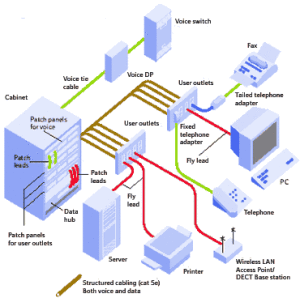
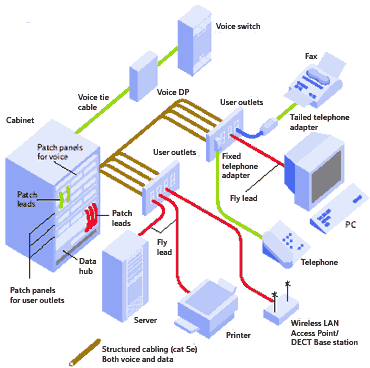
structured cabling, Network Cabling, Data CablingThe structured cabling system is a comprehensive structure of wiring and the related hardware involved. This system ensures a complete and reliable telecommunications infrastructure. This network has several  but mostly for providing telephone services or conveyance of data over a  computer network. This type of cabling system also connects to the internet at the demarcation point.


A quality structured cabling installation has these common elements:


  • It must fir the architectural configuration of the building that hosts  cabling installation

  • It made up of cable and connection fixtures

  • It connects equipment that cabling is setup to support

  • Can be designed to enable retrofitting and upgrading

  • Meets the objectives and requirements of the business

  • Is backed by a guarantee by the manufacturer and the installer


As installers, we use standardized techniques in the completion and upkeep of cabling systems. This is important to guarantee satisfactory system performance on a technically complicated infrastructure. The benefits of adhering to these standards are that they insure stability of connectivity after setup.


 Structured cabling installations may include:


  • Entrance facilities

  • Perpendicular and horizontal backbone conduits or cables

  • Horizontal lanes

  • Work area facilities

  • Equipment areas

  • Telecommunications racks and cabinets


A cabling connector refers to the mechanical device used in connecting a cable to a device or from one cable to another. The connector provides the coupling device that can minimize losses.  For fiber, it permits light signals to move from one connector to another. On the other hand, copper enables electrical impulses to be conveyed. It is important to properly align these  connectors to prevent connectivity breaks. Likewise, it should insure the efficient transmission of data. Connectors are crucial to the reliability of the total telecommunications network.


There are six subsystems in the structured platform. These are entrance facilities, equipment rooms, backbone cabling, telecommunication rooms and enclosures, the cabling, and the work area.  The first consists of cables, network boundary, hardware for connection, security devices, and equipment attached to the network cabling. Backbone cabling consists of subsystems that provide inter-connection between telecommunication, network equipment and access facilities.  Quite often these are the higher speed cabling components such as Cat6 and fiber that connect among the switches of an office.


Horizontal cabling connects from the desktops and phones to the telecommunications rooms and enclosures. The maximum horizontal cable length should be at no more than 100 meters. These desktop components extend out from the wall plate connection end of the horizontal cabling system to the equipment in the wall closet.


Call us if you need troubleshooting or if you have a need for cabling at your office due to expansion or relocation of your firm. We do free on-site surveys and quotes.

data cabling,network cabling,cat6 cable .

PVC Sleeves And Insulation on Fiber-Optic Cable

14 Oct 2014

PVC data cabling,network cabling,cat6 cable .pvc-sleeve- is a common plastic materials for different many uses and applications. PVC is flexible, cost-effective and hard-wearing. Plasticized PVC is considered on of the most popular materials not only for electrical insulation but also for data and fiber optic cables too.


PVC is Polyvinyl chloride. It can be bent and turned many times without cracking or warping. This safety feature makes it appropriate for multiple applications. The infusion of plasticizers provides the needed softness for the insulation and covering of electrical and data wires. Cable wire manufacturers can configure different thicknesses

Read More

Structured Cabling,Washington DC New York City

Types Of Cabling Racks

20 Jul 2014

Cat6, Network Cabling, Data Cabling,cabling rackc 2Effective cable management is vital to maintaining tidiness in a data facility. Cabling racks are used to prevent twisting of optical cables and communications wiring. Remember that the cabling process is very clear-cut. Hence, if a single cable becomes misplaced, it can affect the whole bundle is and the repair process can involve a lot of troubleshooting. This is expensive and a waste of time.


The Local Area Network or LAN is made up of multiple networking devices. Some of these components are Unified Threat Management solutions, routers, servers, switches, modems, and cables.

Read More

Network Cabling, Data Cabling,ladder trays

Ladder Trays For Cable Management

9 Nov 2023

 Network Cabling, Data Cabling,ladder traysCable management is an important function. There are numerous concerns that you need to consider regarding proper usage and arrangement. Having too many cables in a tray is a safety issue. It can also cause poor operational performance. And it can also make replacing and relocating a cable very difficult. So please refrain from overloading cable trays. Overhanging cable trays are mounted on ceilings or supported by a bracket at the bottom. Again, be careful because a heavy tray can fall.


Ladder trays are sometimes fitted with solid covers. They serve as protection

Read More

Network Cabling, Data Cabling

Bad Connectors will Kill your Network

3 Jul 2014

A client was having serious connectivity and network issues. It was a very small business with just a few computers. But as they were working, a couple of the machines were losing their connection to the Internet. The problems and symptoms had been going on for over a year. They would lose Internet connection and they figured out that if they unplugged and replugged the network cable that the connectivity would usually come back. But sometimes, they would have to unplug and plug a few times to get connected. As you could imagine, this was incredibly frustrating for them.


Fortunately, we found and fixed the problem very quickly.


When network connections are flaky we always first look at the cabling and then the hardware and software. And since this was a network-wide problem, we had a strong feeling that they either had a cabling issue or a bad network switch.


In Figure 1, we took a photo of the connector that was going into the modem/router. If you look closely, you can see that the sleeve ends just short of the connector. This is so wrong. The sleeve needs to go inside of the connector so that it provides support and strain-relief to the 4 twisted pairs of wires. The wires would get bent at 90 degrees which changes the impedance and properties of the signal. Figure 2 is the inside of one of the wallplates. As you can see, the wires are untwisted and then punched into the slots for each of the 4-pairs. But they are untwisted too much.There should be no slack in between the sleeve and the connections. So, again, this will greatly reduce the effectiveness of the data transmission.


All cable connections and wallplates were checked and fixed. We cut off the bad connectors and recrimped on new ones. And we reterminated the wallplate. Since then, they have had 100% uptime on the Internet Service.


Are you having network cabling issues? Call 202-462-4290 or click here to contact us.

Network Cabling, Data Cabling,basket type cable tray

Basket Trays

3 Jul 2014

 Network Cabling, Data Cabling,basket type cable trayThe basket type of cable tray is made from wire lattice. The tray provides a foundation for data cables and it facilitates cable management since wires are mounted along and inside the tray. Data cabling is generally smaller but heavier than electrical wires because they are bundled and carried by these trays. A solid steel tray is preferred if heavier cables will be installed but steel is more vulnerable to rusting and exposure to elements. On the other hand, basket trays are lighter than solid racks.


The basket makes cable management and distribution less complicated

Read More

Network Cabling, Data Cabling , cable tray

Uses And Benefits Of Cable Trays

25 Jun 2014

 Network Cabling, Data Cabling, cable traysThe cable tray is meant to prop up insulated cables for communication and power distribution. Cables are mounted on the tray, rather than placed inside a pipe. It can be likened to the structural cog of the building’s electrical layout, as it protects the cables both inside and outside. Wires are organized properly so wire maintenance is easier.


A cable tray facilitates the process of tracking down where wires come from for repairs, and also creates effective fire sealing between wall panels.

Read More

Network Cabling, Data Cabling

Primary Uses Of Cabling Wall Conduit

19 Jun 2014

 Network Cabling, Data Cabling,Wall ConduitThe wire conduit refers to the pipe where cabling passes through. This duct protects insulation and isolates cable wiring. National and local building codes generally require the use of a particular type of conduit for safety and health reasons. The cable conduit is different from the electrical variety. You can install cabling conduits in between walls even if you will not use these pipes immediately; in fact, it is easier and more cost-effective to lay out the conduit during the construction phase.

Read More