Why Your Company Should Avoid CCA Cabling – Part 1
If your company has a limited budget for network infrastructure, your team may be tempted to find numerous way to economize. Unfortunately, this may lead to buying CCA cabling in order to save money. Although marketed as a sufficient substitute for solid copper cabling, CCA cables are far from being the right answer for trimming budgets.
Definition of CCA
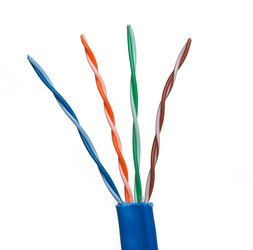
CCA stands for copper coated aluminum. A CCA cable’s core is an inner aluminum conductor that is coated with copper. As a result, it weighs considerably less than solid copper cables.
A CCA cable can be made at a significantly reduced cost than the solid copper version. This gives a manufacturer an increased profit margin and a significant competitive edge over those companies who continue making solid copper cable.
CCA cables may look similar and are advertised to function just like standard CAT5e or CAT6 cabling, but they have serious flaws that could result in network issues, business continuity problems, and safety hazards as discussed below.
Non-Compliant
CCA twisted pair cables are non-compliant with UL and TIA standards, which require solid or stranded copper conductors. The National Electrical Code (NEC) also does not provide CCA cabling a valid safety listing. Thus, CCA cables cannot be installed legally if the facility requires CM, CMG, CMP, CMR, or CMX rated cables.
Inflexible
As CCA conductors are brittle and easily break, just transferring a faceplate or patch panel can result in failures. CCA wires have low tensile strength, and they are known to break from shearing or pulling, which can happen during packaging or delivery. Moreover, CCA cables have a very limited bend radius.
Oxidation
Aluminum begins oxidizing very rapidly when it is exposed to air. This oxidation and the resulting corrosion may lead to failed terminations inside the network infrastructure, resulting in connectivity issues.
Part 2 will continue discussing CCA cabling related issues and counterfeit copper cabling.
Progressive Office Cabling
Founded in 1986, Progressive Office’s success has been a direct result of years of commitment to seeking solutions on behalf of our clients in the Washington, D.C. and New York City areas. Efficiently working together, Progressive teams get cabling installed and operating as fast as possible while minimizing disruption and downtime. Call our toll free number (800) 614-4560 today.

Top Ten Tips for Business Data Cabling – Part 2
As discussed in Part 1, business cabling projects can be a challenge to properly design, install, and accomplish on schedule. The key to success is finding an experienced team that will provide structured cabling services of high quality. Part 2 will discuss Maintaining Standards, Planning Well, Respecting Regulations, Staying Up-to-Date, and Testing Infrastructure.
Maintaining Standards
Maintain the established standards and best practices of structured cabling. Neglecting to do so will probably reduce quality and the efficiency of a data network. For guidance, refer to the standards set forth by the Telecommunications Industry Association.
Planning Well
Planning well will help future proof your organization. Do your best in estimating what your company will need for the next five years. CAT5E is now the standard, and it can support a maximum of 1000 Mbps. If your company needs more bandwidth, CAT6 is rated at a maximum of 10 Gbps. Re-cabling soon after installation will be disruptive and expensive.
Respecting Regulations
Compliance with codes, laws, and ordinances typically protects the lives of employees and first responders. A company found to be violating regulations will be fined and required to rewire the cabling so it is up to code. In the event of injury or death that is attributable to a violation, individuals found responsible may be held financially and perhaps criminally liable.
Staying Up-to-Date
Staying current with technological developments and regulations related to structured cabling and IT infrastructure will allow you to provide guidance to your company that has foresight. Knowledge of trends will let you anticipate what your IT infrastructure will need in the future.
Testing Infrastructure
Testing IT infrastructure during the installation of cabling is good practice. For efficiency, tests should be performed in phases to detect and fix problems quickly. Testing only after the installation of hundreds of feet of cabling will discover issues far too late and result in time wasteful revisions, repair, or replacements.
Progressive Office Cabling
Founded in 1986, Progressive Office’s success has been a direct result of years of commitment to seeking solutions on behalf of our clients in the Washington, D.C. and New York City areas. Efficiently working together, Progressive teams get cabling installed and operating as fast as possible while minimizing disruption and downtime. Call our toll free number (800) 614-4560 today.

Basics and Benefits of Zone Cabling – Part 2
As mentioned in Part 1, zone cabling designs provide benefits in materials savings, decreased installation times, and easier MACs (moves, adds, and changes). Part 2 will continue discussing the basics and benefits of zone cabling.
Designs
Experts recommend CAT 5e and 6 UTP (unshielded twisted pair) zone cabling topology with a connecting block system within the ZE (zone enclosure). This configuration will render unnecessary the stocking of factory pre-terminated and tested interconnect cords for connections in the ZE, simplifying cable management through the elimination of cable slack.
Please note that CAT 6A UTP media is not recommended for zone cabling due to reasons involving performance and flexibility. UTP cabling is vulnerable to crosstalk in particular installation scenarios. In addition, it is not the best media for supporting remote power applications with loads of 30W or more. Because CAT 6A UTP zone deployment is dependent on modular connections inside the ZE, connections provided by pre-terminated and tested interconnect cords need to be available for rapidly enabling MACs. Affordable shielded zone cabling solutions are recommended to address these situations.
Cost Savings
Even though more CAPEX (capital expenditure) will be necessary for a zone cabling installation, assessing total costs should also account for OPEX (operating expenditure). The performance of MACs is classified as OPEX, and studies by Siemon found there are hundreds of dollars in savings from each move, addition, or change when using a zone cabling design versus a traditional cabling design. Their study also discovered a tipping point when ROI begins accruing from utilizing a zone cabling design.
IT (information technology) needs for many organizations evolve constantly, which requires being able to quickly reconfigure floor space. An improved capability of supporting MACs will allow owners of facilities to achieve considerable ROI benefits from deploying zone cabling systems in a two to five year period. According to Siemon, the combined costs of CAPEX and OPEX for zone cabling designs will be invariably less than traditional cabling designs
Part 3 will continue discussing the basics and benefits of zone cabling.
Progressive Office Cabling
Founded in 1986, Progressive Office’s success has been a direct result of years of commitment to seeking solutions on behalf of our clients in the Washington, D.C. and New York City areas. Efficiently working together, Progressive teams get cabling installed and operating as fast as possible while minimizing disruption and downtime. Call our toll free number (800) 614-4560 today.

The 5 Most Common Structured Cabling Errors – Part 1
Structured cabling systems are so standardized that good practices should merely entail following ISO/IEC, CENELEC or Telecommunications Industry Association (TIA) documentation for panel and outlet standards, cable pathway standards, maximum cable and patch cord lengths, patch testing standards, etc. Strictly doing so will invariably result in an installation that is professional and trouble free. In addition, as data speeds grow faster and faster, following industry standards becomes even more crucial.
Improperly installed cabling made up of shorter runs, which do not overly stress the system, may function well enough. In addition, data speeds may be quite beneath the cable specification capacity. As an example, CAT5e carrying 100Mbps and capable of 1Gbps will have ample margin of error. However, structured cabling systems still need qualified technicians for proper installation supporting maximum data speeds over the entire network as required.
The following will discuss the five most common errors of structured cabling. Remember to call an experienced and expert cabling installation team to get the best results for your company’s project.
Error No. 1
Considering cables as merely wiring is the first error. They are actually very important electronic components that provide the pathway for data from point to point within a network. These points may be a desktop PC, a network switch, server, router, and wireless access point. When you consider that cables make these connections possible, then you can understand how important it is to make sure that the cabling is of high quality and properly installed.
Error No. 2
Running data cables near power cables is the second error. Even when cables are screened, this practice is unsound. When data cables are running near and parallel to power cables, noise emitted by power cables may infiltrate data cables. As the load carried by power cables fluctuate, resulting spikes or surges may radiate into the data cables, creating undesired noise decreasing the quality of the data transmission.
Part 2 will discuss three more common errors of structured cabling.
Progressive Office Cabling
Founded in 1986, Progressive Office’s success has been a direct result of years of commitment to seeking solutions on behalf of our clients in the Washington, D.C. and New York City areas. Efficiently working together, Progressive teams get cabling installed and operating as fast as possible while minimizing disruption and downtime. Call our toll free number (800) 614-4560 today.

Why Structured Cabling is Important for Business Phones
If your organization is considering a new VOIP (Voice Over Internet Protocol) system, you should think about the structured cabling system needed to support it and maximize its potential. The following summarizes the advantages your digital phone system will have with a well-designed structured cabling system.
Decreased Noise
CAT 6 and CAT 6A cable provides more noise reduction than older cables. Fiber optic cabling is even better. Less noise resistance results in more static and faulty connections during phone conversations. Higher levels of noise also decrease network speed because the system is forced to retransmit data until it is no longer corrupted. Although purchasing lower quality cable saves money in the short run, it may result in long term business losses because of slower response times and annoyed customers.
Lengthened Runs
Higher quality cable will be capable of supporting longer runs that are free of artifacts and errors. Fiber optic cables are not restricted by the length of runs. It is the superior option for a data center or business telephone system because of its excellent noise resistance and high speed. Although second choices, CAT 5e to CAT 6A cabling are capable of supporting runs to 100 meters without noise. Cables that can support long runs provide greater flexibility for layouts, decreasing the need for data hubs or repeaters and increasing reliability.
Maintenance Savings
CAT 5e, CAT 6, and fiber optic cables are highly dependable. However, if they ever become faulty or the network needs to be reconfigured, a structured cabling system that is well organized and diligently marked will save time spent on maintenance. While a company’s network is down, business may be impacted, resulting in lost revenue. Tracing faults is made much easier by a sound structured cabling system.
Transmission Speed
Business is often time-sensitive, and you will want to use the highest quality cable your company can afford. CAT 6A cable is capable of supporting a maximum of 10 Gigabits per second while CAT 5e can only achieve 100 mbps. Older, less capable cables are not recommended because their slow data transmission and high noise levels cannot meet current VOIP demands.
Progressive Office Cabling
Founded in 1986, Progressive Office’s success has been a direct result of years of commitment to seeking solutions on behalf of their clients in the Washington, D.C. and New York City areas. Efficiently working together, their teams get cabling installed and operating as fast as possible while minimizing disruption and downtime. Call their toll free number (800) 614-4560 today.

Data Center Cabling Best Practices – Part 3
As mentioned previously, modern data centers must be flexible, scalable, reliable, and manageable, making best practices required. Part 3 will cover Color Identification and Naming Scheme.
Color Identification
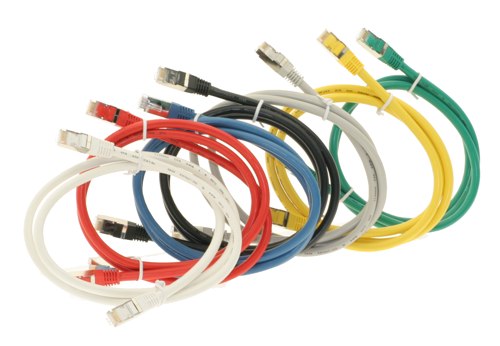
A method of fast visual identification, color coding makes management simpler, conserving time spent on the tracing of cables. Patch panel ports can also be coded, and various colored jacks and inserts are also coded. As determined by a particular manufacturer’s own color scheme, cables are available in numerous colors, each of which can be made applicable to the specific function of a cable or connection type.
Color schemes are expandable through the use of color bands at the end of every cable, using various colored sleeves and colored ports on the patch panel. However, it will also be necessary to use a secondary non-color scheme to make it possible for those who are color blind to identify the cables.
Naming Schemes
After determining the physical layout for the cabling that will be used, use a naming scheme that can be logically applied for facilitating fast and effortless identification of every cable component. Labeling can be an especially effective way to improve team communication among staff members because it makes confusion and uncertainty unlikely when a colleague must search for a particular component. Clear labeling is integral to the success of the naming scheme, and it should not be neglected.
A good naming scheme documents and labels every cable component. The following is the typical hierarchy for a naming scheme: Building, Room, Rack, Patch Panel, Workstation Outlet, Port, and Cable. Each should receive a designation indicating its location preceded by the area(s) above it. For example, Rack A03 would receive the designation SJ01-5D11-A03, if Room is designated SJ01-5D11, and Building is designated SJ01.
Upon the approval of the naming scheme, your team can begin labeling components. The team should prioritize drafting a manual that details the naming scheme and include it as part of the training program for newly hired data center administrators.
The Best Practices for Cable Component Selection will be discussed in the next series.
Union Network Cabling
When your work requires a unionized cabling group, call on Progressive Office Inc. for your commercial Cat5e/6/6a and fiber cabling projects. Specializing in cabling for data, voice, security and even the latest WiFi and LiFi solutions. Phone: (202) 462-4290

The Organizations that Set Cabling Standards
The TIA (Telecommunications Industry Association) and the ISO (International Organization for Standardization) are the primary organizations that oversee the development of structured cabling standards for the industry. Committees formed by the IEEE (Institute of Electrical and Electronics Engineers) provide assistance through testing and setting performance specifications for various standards.
Compliance with standards ensures the functioning of systems at specified levels, backward compatibility, and a greater selection of equipment will exist. General global recognition of standards permit utilizing equipment sourced from various countries inside computer systems. Requirements for the components of optical and copper cabling including cables, assemblies, connectors, cabling spacing and pathways, administration, field testing, and installation are standardized to make worldwide acceptance possible.
Technicians in North America typically use TIA standards, while the rest of the world uses ISO standards. Examples of organizations that set regional and national standards organizations are CENELEC (European Committee for Electrotechnical Standardization), CSA (Canadian Standards Association) and JSA (Japanese Standards Association). Their standards are generally compatible with TIA and ISO.
Different terminology used by TIA and ISO Associations sometimes cause confusion because they refer to the same item. For example, what the TIA terms as Cat5e is what ISO terms to be Class D. However, adherence to standards set by TIA and ISO ensure system cabling requirements are properly implemented in the categories below.
- Insertion Loss – Decrease of signal strength down the transmission line.
- Return Loss – Measurement of signal reflections on the cable.
- NEXT – Near End Crosstalk Loss due to signal coupling.
- Propagation Delay / Delay Skew – Elapsed time for signal to reach other end of cable or the delay between signal arrival at far end on slowest and fastest cable pairs.
- ACR – Difference between insertion loss and NEXT.
- ELFEXT – Identical to NEXT, but for cabling system’s far end.
- PSANEXT / PSAACRF – Power sum alien crosstalk at near end / Power sum alien crosstalk at far end.
Due to ever-increasing data rates, the efforts of the standards organizations are assuming greater importance in terms of ensuring proper system design.
Union Network Cabling
When your work requires a unionized cabling group, call on Progressive Office Inc. for your commercial Cat5e/6/6a and fiber cabling projects. Specializing in cabling for data, voice, security and even the latest WiFi and LiFi solutions. Phone: (202) 462-4290

Data Center Cabling Best Practices – Part 2
As mentioned in Part 1, modern data centers must be flexible, scalable, reliable, and manageable, making best practices required. Part 2 will cover cabling for Modular Data, High Density/High Port Count Fiber Equipment, and Standards.
Modular Data
Increasing in popularity, modular cabling systems for fiber and copper connectivity introduces the plug-and-play concept, which simplifies cable installation and significantly decreases costs and labor. Typically, cables are factory-terminated and tested.
While modular cabling is less costly when the infrastructure is modified in-house, it will not be as flexible because of the possible required commitment to a vendor for ongoing compatibility.
High Density/High Port Count Fiber Equipment
When networking equipment gradually grows in density and port counts rise to several hundred, the proper management of the connected cabling will also require increased effort.
In the past, the direct connection of cables to individual ports of equipment with low port-counts was thought to be manageable. Unfortunately, the same task will be very time consuming for high-density/high-port-count equipment. Eventually, the addition or removal of cables directly connected to these ports will be almost impossible.
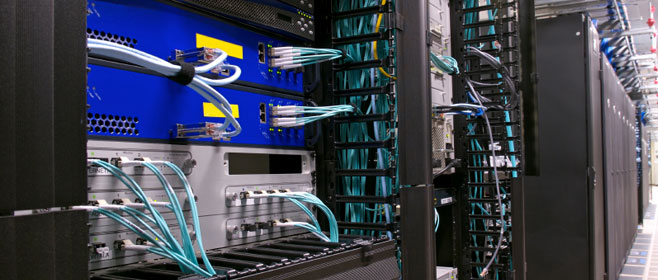
The utilization of Multifiber Push-On (MPO) cable assemblies featuring a single connector at one end of cable and multiple duplex breakout cables at the other end will ease cable management.
The concept revolves around pre-connecting high-density/high- port-count Lucent Connector (LC) equipment with LC-MPO fan-out cable to dedicated MPO modules inside a dedicated patch panel. Once completely cabled, this patch panel will work as "remote" ports. Ideally the patch panels should be located on top of the cabling equipment to facilitate access to overhead cabling. This method significantly decreases cluttering of equipment and cables, resulting in improved cable management.
Standards
The ISO (International Organization for Standardization) and TIA (Telecommunications Industry Association) are the main organizations that develop structured cabling standards for the industry. IEEE (Institute of Electrical and Electronics Engineers) committees do the testing and then set performance specifications.
Standards compliance makes sure that systems function at specified levels, allows backward compatibility, and a greater variety of equipment will be available internationally. Widespread global acceptance of standards allows the sourcing and use of equipment manufactured by different countries.
Color Identification and Naming Scheme will be discussed in Part 3.
Union Network Cabling
When union work requires a unionized cabling group, call on Union Network Cabling for your commercial Cat5e/6/6a and fiber cabling projects. Specializing in cabling for data, voice, security and even the latest WiFi and LiFi solutions. Phone: (202) 462-4290