IT Support,Data Cabling,Atlanta GA

The Organizations that Set Cabling Standards

27 May 2017

Data Cabling,Network Cabling,Atlanta GAThe TIA (Telecommunications Industry Association) and the ISO (International Organization for Standardization) are the primary organizations that oversee the development of structured cabling standards for the industry. Committees formed by the IEEE (Institute of Electrical and Electronics Engineers) provide assistance through testing and setting performance specifications for various standards.


Compliance with standards ensures the functioning of systems at specified levels, backward compatibility, and a greater selection of equipment will exist. General global recognition of standards permit utilizing equipment sourced from various countries inside computer systems. Requirements for the components of optical and copper cabling including cables, assemblies, connectors, cabling spacing and pathways, administration, field testing, and installation are standardized to make worldwide acceptance possible.


Technicians in North America typically use TIA standards, while the rest of the world uses ISO standards. Examples of organizations that set regional and national standards organizations are CENELEC (European Committee for Electrotechnical Standardization), CSA (Canadian Standards Association) and JSA (Japanese Standards Association). Their standards are generally compatible with TIA and ISO.


Different terminology used by TIA and ISO Associations sometimes cause confusion because they refer to the same item. For example, what the TIA terms as Cat5e is what ISO terms to be Class D. However, adherence to standards set by TIA and ISO ensure system cabling requirements are properly implemented in the categories below.


  • Insertion Loss – Decrease of signal strength down the transmission line.

  • Return Loss – Measurement of signal reflections on the cable.

  • NEXT – Near End Crosstalk Loss due to signal coupling.

  • Propagation Delay / Delay Skew – Elapsed time for signal to reach other end of cable or the delay between signal arrival at far end on slowest and fastest cable pairs.

  • ACR – Difference between insertion loss and NEXT.

  • ELFEXT – Identical to NEXT, but for cabling system’s far end.

  • PSANEXT / PSAACRF – Power sum alien crosstalk at near end / Power sum alien crosstalk at far end.


Due to ever-increasing data rates, the efforts of the standards organizations are assuming greater importance in terms of ensuring proper system design.


Union Network Cabling


When your work requires a unionized cabling group, call on  Progressive Office Inc. for your commercial Cat5e/6/6a and fiber cabling projects. Specializing in cabling for data, voice, security and even the latest WiFi and LiFi solutions. Phone: (202) 462-4290
Cat5e Cat6/6a Cabling,Office Cabling

Data Center Cabling Best Practices – Part 2

13 May 2017

Cat5e Cat6/6a Cabling,Office CablingAs mentioned in Part 1, modern data centers must be flexible, scalable, reliable, and manageable, making best practices required. Part 2 will cover cabling for Modular Data, High Density/High Port Count Fiber Equipment, and Standards.


Modular Data


Increasing in popularity, modular cabling systems for fiber and copper connectivity introduces the plug-and-play concept, which simplifies cable installation and significantly decreases costs and labor. Typically, cables are factory-terminated and tested.


While modular cabling is less costly when the infrastructure is modified in-house, it will not be as flexible because of the possible required commitment to a vendor for ongoing compatibility.


High Density/High Port Count Fiber Equipment


When networking equipment gradually grows in density and port counts rise to several hundred, the proper management of the connected cabling will also require increased effort.


In the past, the direct connection of cables to individual ports of equipment with low port-counts was thought to be manageable. Unfortunately, the same task will be very time consuming for high-density/high-port-count equipment. Eventually, the addition or removal of cables directly connected to these ports will be almost impossible.


The utilization of Multifiber Push-On (MPO) cable assemblies featuring a single connector at one end of cable and multiple duplex breakout cables at the other end will ease cable management.


The concept revolves around pre-connecting high-density/high- port-count Lucent Connector (LC) equipment with LC-MPO fan-out cable to dedicated MPO modules inside a dedicated patch panel. Once completely cabled, this patch panel will work as "remote" ports. Ideally the patch panels should be located on top of the cabling equipment to facilitate access to overhead cabling. This method significantly decreases cluttering of equipment and cables, resulting in improved cable management.


Standards


The ISO (International Organization for Standardization) and TIA (Telecommunications Industry Association) are the main organizations that develop structured cabling standards for the industry. IEEE (Institute of Electrical and Electronics Engineers) committees do the testing and then set performance specifications.


Standards compliance makes sure that systems function at specified levels, allows backward compatibility, and a greater variety of equipment will be available internationally. Widespread global acceptance of standards allows the sourcing and use of equipment manufactured by different countries.


Color Identification and Naming Scheme will be discussed in Part 3.


Union Network Cabling


When union work requires a unionized cabling group, call on Union Network Cabling for your commercial Cat5e/6/6a and fiber cabling projects. Specializing in cabling for data, voice, security and even the latest WiFi and LiFi solutions. Phone: (202) 462-4290

Data Cabling,Structured Cabling, Cabling Design-Washington DC

Structured Cabling Benefits for Your Business

28 Apr 2017

 Structured cabling, cable, Washington DCThe structuring of cabling will result in better organization and easier management of the cables. If you are a building manager or business owner, you may already know a bit about structured cabling. You may be currently thinking about its installation in your premises. In the most basic terms, structured cabling allows for several devices like computers and telephones to be connected via a cabling system infrastructure. The following discusses several benefits of structured cabling for a facility or office. Consult with experienced structured cabling professionals to get the best results.


Adaptability


Structured cabling is technology that allows business managers to plan and prepare for the future, making its implementation a valuable investment. Structured cabling that installs a newer cable such as Cat 6 will provide adequate bandwidth, making it viable for an extended period as a business’ IT needs gradually expand. The high bandwidth of a structured cabling system will also give a business the increased ability to adapt newer applications, devices, and technologies.


Diagnosis and Repairs Made Easier


Whenever issues occur on multiple, disorganized cabling systems, determining the source of the problems will be difficult. Although structured cabling is a unified system, it is organized in segments, making it much easier for technicians to locate malfunctions and repair them.


Flexibility at Lower Costs


The people, equipment, and offices of an organization are not static. Businesses evolve and restructure as time passes. Employees of a department may have to move to another area. The entire area of an office may also need renovation. Typically, changes like these grind business to a halt, hurting the bottom line. However, a structured cabling system allows a company’s staff to move to another part of an office, connect, resume working, and remain productive without missing a beat.


Networking


Employees will also be able to connect their devices into any outlet of a structured cabling system as opposed to a particular wire, promoting flexibility and productivity. In addition, a structured cable system will be able to convey data in multiple forms, allowing staff on a network to connect with other computers, servers, printers, and telephones.


Simplified Management


One of the greatest advantages of a structured cabling system is the elimination of disorganized and unsightly wires. The replacement of a configuration using multiple cabling with a structured cabling system will result in easier and less costly management by technicians as they will save time on repairs and restructurings.


Union Network Cabling


When union work requires a unionized cabling group, call on Union Network Cabling for your commercial Cat5e/6/6a and fiber cabling projects. Specializing in cabling for data, voice, security and even the latest WiFi and LiFi solutions. Phone: (202) 462-4290

Structured Cabling, Washington DC, New York City

Resolving Vital Issues in Network Cabling

5 Jun 2015

 Structured Cabling ,Washington DC New York CityThe quality of information flow is no better than the medium that carries it. This is the cabling network. The structured cabling platform will ensure that information flows efficiently through the cabling system. It consists of transmission tools applied according to standard engineering designs that enable users to transmit voice and data signals.
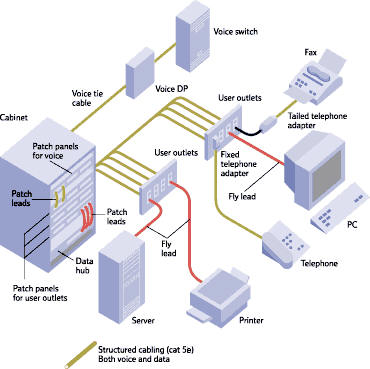

The controlled cabling system is the foundation and essential investment that provides a common, mutual platform for multiple information technology systems. However, there can be problems and information flow can be obstructed because of an information technology structure that has been designed improperly. Therefore, it is necessary to tackle crucial concerns in structured cabling during the planning stage.

Read More

structured cabling, Data Cabling ,Cat5e, Cat6/6a Cabling

Powerful Networks in Structured Cabling

16 May 2015

structured cabling, Data Cabling ,Cat5e, Cat6/6a CablingIt is known that structured cabling systems are fabricated to guarantee that information flows efficiently through the network. Such system are made up of transmission products installed based on appropriate guidelines in engineering design. These enable users to put into operation voice and data systems that capitalizes on speed.


This particular configuration has emerged as shared platform for multiple information technology applications. These include voice and data, building automation, security mechanisms, telecommunications conferencing, and fire alarms. This union transformed the structured cabling platform into the most essential network element. Therefore, it calls for a crucial investment in a very reliable, adaptable and scalable cabling structure.


High-performance Networks


This efficient and complex cabling scheme segregates the whole infrastructure into controllable blocks. After that, it puts them together to come up with a high-performance network. This end product is the vital link for many enterprises and all data hubs. Such a system facilitates consistency across the network particularly for commercial building structures. Consistency generates cost-effectiveness by standardizing maintenance processes, cutting down on manpower requirements, and improving reliability.


The “structured” design makes possible easy management by identifying specific distribution points, regular labeling and color codes, cabling management, and distribution techniques. As a rule, data facility managers use dynamic methodologies to fill the center with information technology equipment. This accommodates the evolving needs of business operations which frequently compel the need for the most modern IT equipment. Since companies rely on equipment as well as infrastructure, management believes requirements for additional IT capability should be made promptly. If the infrastructure is below par, upgrades will be much more difficult.


Crucial Concerns


The best IT specialists see to it that problems in structured cabling systems are dealt with immediately. One of the primary concerns is to employ highly competent service providers and coordinate entry points/space for each provider. This procedure enhances flaw tolerance of the overall system design. The high-performance model supports aggregate telecommunications requirements and thereby leads to a maximum returns on investments.


Centralized Intermediate Distribution Frames (IDFs) should be in centralized locations in the office facility. This will produce efficient cable management and will ease the addition of new equipment. This design technique has been adopted to avoid any disruption of the data unit or minimized once changes or upgrades are implemented. Telecommunications rooms contain the IDFs, main distribution frames and entrance facilities. Switches are installed in the middle of server rows for economical management.


Please contact us if you have any questions or concerns about your office network cabling.

Structured Cabling,,Office Cabling.connectors

Important Facts About Cabling Infrastructure

23 Jan 2015

NetworkStructured Cabling,,Office Cabling.connectors cabling that has not been installed properly may result in various communications issues. Even minor problems such as a connector that has not been terminated properly can prevent Power over Ethernet from performing well.


Wiring Standards


See to it that you use appropriate wiring patterns which are T568a and T568b. Refrain from bringing together T568a and T568b in the same cable. And always use premium quality Cat6 or Cat5e cables. We prefer solid over stranded wire.

Read More

Structured-Cabling,Data Cabling

Essential Issues in Design of Structured Cabling Systems

13 Jan 2015

Structured-Cabling,Data CablingStructured cabling systems (SCS) refers to the local area network  cabling system designed exclusively to fit a company's requirements. It combines data, voice, video, and management systems sometimes including alarm and security. SCS insures that all of this information is transmitted promptly and efficiently. The structured cabling system normally includes transmission products with engineering design rules that create a stable transmission system.


Network Foundation


The structured cabling system is said to be the groundwork of a successful building and office setup. It is also the fundamental foundation on which all other equipment relies on.

Read More

Network Cabling Data Cabling

Fundamentals of Structured Cabling Systems

15 Nov 2014

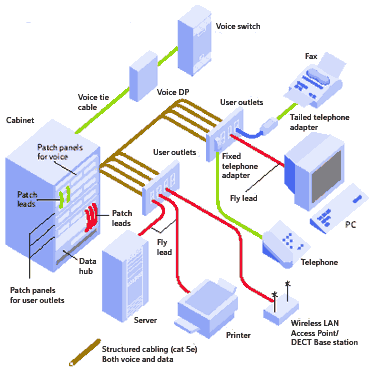
structured cabling, Network Cabling, Data CablingThe structured cabling system is a comprehensive structure of wiring and the related hardware involved. This system ensures a complete and reliable telecommunications infrastructure. This network has several  but mostly for providing telephone services or conveyance of data over a  computer network. This type of cabling system also connects to the internet at the demarcation point.


A quality structured cabling installation has these common elements:


  • It must fir the architectural configuration of the building that hosts  cabling installation

  • It made up of cable and connection fixtures

  • It connects equipment that cabling is setup to support

  • Can be designed to enable retrofitting and upgrading

  • Meets the objectives and requirements of the business

  • Is backed by a guarantee by the manufacturer and the installer


As installers, we use standardized techniques in the completion and upkeep of cabling systems. This is important to guarantee satisfactory system performance on a technically complicated infrastructure. The benefits of adhering to these standards are that they insure stability of connectivity after setup.


 Structured cabling installations may include:


  • Entrance facilities

  • Perpendicular and horizontal backbone conduits or cables

  • Horizontal lanes

  • Work area facilities

  • Equipment areas

  • Telecommunications racks and cabinets


A cabling connector refers to the mechanical device used in connecting a cable to a device or from one cable to another. The connector provides the coupling device that can minimize losses.  For fiber, it permits light signals to move from one connector to another. On the other hand, copper enables electrical impulses to be conveyed. It is important to properly align these  connectors to prevent connectivity breaks. Likewise, it should insure the efficient transmission of data. Connectors are crucial to the reliability of the total telecommunications network.


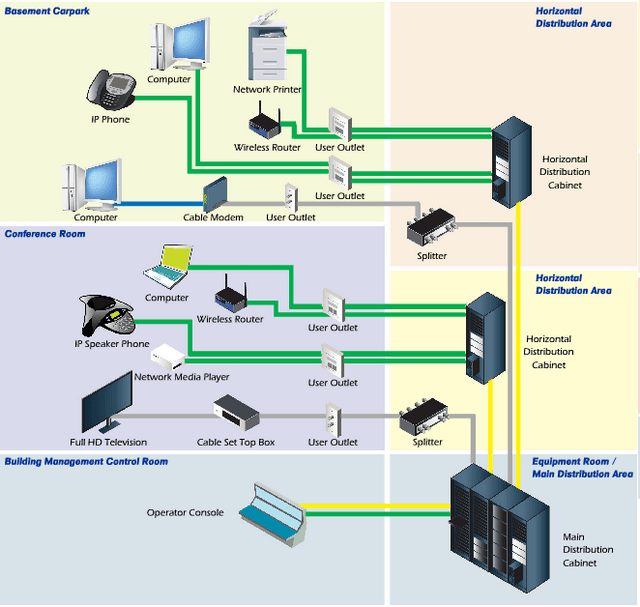
There are six subsystems in the structured platform. These are entrance facilities, equipment rooms, backbone cabling, telecommunication rooms and enclosures, the cabling, and the work area.  The first consists of cables, network boundary, hardware for connection, security devices, and equipment attached to the network cabling. Backbone cabling consists of subsystems that provide inter-connection between telecommunication, network equipment and access facilities.  Quite often these are the higher speed cabling components such as Cat6 and fiber that connect among the switches of an office.


Horizontal cabling connects from the desktops and phones to the telecommunications rooms and enclosures. The maximum horizontal cable length should be at no more than 100 meters. These desktop components extend out from the wall plate connection end of the horizontal cabling system to the equipment in the wall closet.


Call us if you need troubleshooting or if you have a need for cabling at your office due to expansion or relocation of your firm. We do free on-site surveys and quotes.

Network Cabling Data Cabling

Distinguishing between Cat5 and Cat6 Network Cables

12 Jun 2014

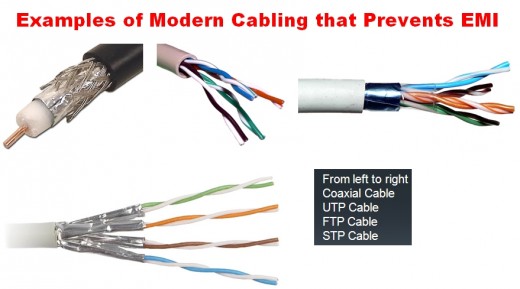
Network cablesCAT 5,Network Cabling Data Cabling connect and transmit information between personal computers, storage area networks and routers. You can now find various models of cables. Your choice may depend on configuration and topology of the system’s architecture. The most common variety is known as twisted pair cable in local area networks. Numerous Ethernet networks use this type of cable. It is composed of four pairs of fine wires or conductors. Each pair is entwined several times to prevent obstruction from other cables and devices.


The CAT5 or Category5 is an example of twisted pair cable

Read More

Structured cabling,Network Cabling, Washinton DC

Continued Dominance of Structured Copper Cabling Systems

28 May 2014

Copper cablingNetwork Cabling ,Data Cabling,copper cabling system will remain dominant in the structured cabling systems industry. This conclusion is based on analysis and forecasts made by several cabling installation companies worldwide. Both copper and optic fiber cabling are used for key structured cabling systems applications like LAN, data centers, and Voice over Internet Protocol (VoIP). Optic fiber is gradually gaining in popularity, but copper cable still seems to be the major preference of most companies.

Read More