Data Cabling Cat5e Cat6/6a Cabling

Punch Down Tools in Data Cabling

22 May 2015

 Data Cabling,Cat5e, Cat6/6a CablingPunch-down tools are important for terminating cables in Insulation Displacement Connector (IDC) connecting blocks, patch bays and terminal jacks. These reliable tools have been present for many years. However, manufacturers do not stop in developing accessibility and labor concerns.


Punching down is the term used for the physical force needed to pierce or take away the cable insulation while the connection is being made. These used to be simple screwdrivers which have evolved into modern gadgets designed with durable rubber, gripping curve and impact mechanisms that reduce the use of force for manual exertion.

Read More

Is it Practical to Use Cat6 Cable?

26 Apr 2015

cat 6,structured cabling, Data CablingData volume has grown extensively. Also, the processing capacity to users continues to get grow. Specialists in data management forecast that information production will be 44 times larger in five years with enterprises needing to process and safeguard 80 percent of the new data.


Data Cables


For these reasons, you might need to become more familiar with different types of cabling. There is Category 5 (Cat5) cable but it is only capable of transmitting 1000 megabits data rate per second on an Ethernet network. Transfer of data demands are increasing due to new and more sophisticated applications. That is why many companies prefer to work with Category 6 (Cat6) cables. Cat6 has a maximum data transfer of 10,000 megabits per second. Cat6 is also backward compatible which means your Cat5 connectors will plug i and work (at the lower speeds).


Future Proofing


Cat6 infrastructure guarantees that your system will be relevant well into the future. This allows users to easily cope with any modifications, new features or technological developments. The Cat5 standard has been used for a long time. However, your enterprise needs adequate bandwidth to handle these continuing and future changes. It is not merely a possibility or “let's say” situation. It is to be anticipated as the online experience continues to progress.


Demand for Cat6 escalates as the world-wide web is now offering premium video streams, online applications, highly-responsive and media-heavy portals.  If you decide to upgrade to a more reliable network, consider Cat6 cables. It is fast becoming the new standard in this industry.


Downsides


Cat 6 is more costly compared to Cat5e cables. On average, we are finding that projects cost about 20-25% more. This is because you are not guaranteed full speed unless all the components operate at gigabit speed. So, you need Cat6 cable, connectors, patch panels and Gigabit switches too. If one part is not rated as gigabit, the network will run at Cat5e speeds. Call or contact us to help you make this decision.


Nevertheless, experts say Cat6 will sooner or later surpass Category 5e.  And the initial upfront costs will pay future productivity gains for many, many years to come.

 
Data Cabling ,Network cabling, DC

Essential Components for Wired Networks

10 Apr 2015

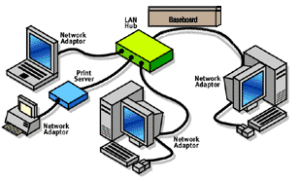
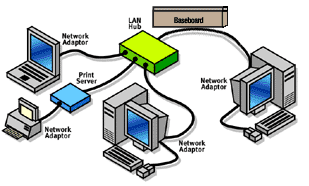
Data Cabling ,Network cabling, DCBe sure to purchase the correct components before you install a wired network. The major components consist of the cable, router and network adapters.


Cables


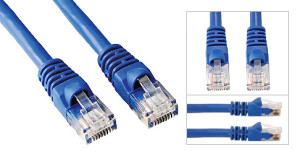
You should opt for fast Ethernet or the 100 Base T cable. Ethernet (RJ-45) looks like telephone cables with somewhat thicker wire and jacks. It is also known as Cat 5e or Twisted Pair Ethernet with corresponding speed ratings of 10, 100, and 1,000. Every PC requires a separate network adapter.

Read More

Directions in Telecommunications and Cabling

3 Apr 2015

 Data Cabling ,Network cabling, DCThe telecommunications industry continues to advance. And bandwidth demands will continue to increase. Meanwhile, conditions to convey considerable amounts of information quickly are changing. Applications including graphic information, technical modeling, video conferencing, and multi-level online databases will certainly increase bandwidth requisites. The bottom line is demand for higher transfer speed for information is expected to rise.


Properties for Cabling Systems


Two principal properties needed for cabling systems are performance and easy installation. Fiber and shielded twisted-pair provide stronger signals compared to Unshielded Twisted Pair (UTP) although these two lagging in client acceptance. The question is will UTP provide the appropriate bandwidth for modern applications?


Unshielded Twisted Pair


UTP is considered the most prevalent cable worldwide for telecommunications and networking. Cat 5e is the most popular and it long ago replaced coaxial cable which failed to keep up with more dependable and faster networks. UTP is also easy to install, develop and troubleshoot. Unshielded Twisted Pair cabling does not have any foil covering. It depends on twisted pairs inside the cable to prevent electromagnetic interference. UTP is used extensively for local area networking and comparable cabling configurations. Hence, installation is easier and less expensive.


Shielded Twisted Pair


Shielded twisted Pair (STP) features a metallic foil enclosing twisted wire pairs inside the cable. This is the safeguard against electromagnetic intervention which facilitates rapid data transmission. STP functions by drawing electromagnetic interference and counterbalancing this with grounded cabling. The drawback is that if the cable is not grounded correctly it loses the capacity to prevent unnecessary noise. STP is also larger and more sensitive compared to UTP cables. Expert cable installers use this cabling for industrial environments where adjacent equipment emit significant amounts of elctron-magnetic interference (EMI). Actually, UTP and STP can perform well if installed and maintained by efficient cabling providers.


Transmission is Essential


Transmission should be balanced. This is the standard for conduction of data using twisted cabling pairs. Separate protection for balanced twisted pairs is designed to enhance resistance and emission of the communication lines. The shielding method produces a conductive barrier that lessens these electromagnetic waves. It also creates a conduit for conduction so that currents and can pass data through without any obstruction. Shielding can be performed on individual pairs or as one set of pairs.


Please contact us if you have any questions or concerns or if you need a free quote on your cabling project.


Cat5e ,Cat6/6a Cabling,patch cables

Patch Cables and Twisted Pair Cabling

21 Mar 2015

The patch cable is used to link up two network devices. This type of cabling is usually a Cat6 or a Cat5e cable thaCat5e ,Cat6/6a Cabling,patch cablest connects personal computers to the wall plate or provides the short interconnects among the switches, routers and the patch panels in the wall closet or Server Room. These make use of stranded wires instead of solid to increase flexibility. It also lessens the risk of cracking when you unplug the cable. There is also a variety of Ethernet patch called the crossover cable. It is used to hook up two PCs together and sometimes to interconnect switches.


Ethernet Systems


Ethernet systems ensure adaptable and economical methods of conveying voice, data, and multimedia over integrated networks. In fact, Ethernet patch cords have become very common. These wall to wall cables gave rise to the growth of generic and structured cabling systems. Today, these are used practically for all networking components regardless of industry or application. However, there are concerns that you need to consider. Whereas modular attributes and profusion of patch cables denote absolute universal use, there are differences that can reduce interchangeability. Some of the disparities originate from various wiring configurations of cable conductors and connector pins.


Twister Pair Cables


For this type of cabling, two conductors are coiled to prevent electromagnetic interference (commonly known as EMI) that comes from external (usually electrical) sources. One example is the electromagnetic radiation caused by uncovered twisted pair cables or UTP as well as cross talk produced by adjacent electrical wires. The process of shielding generates a conductive barrier to lessen these electromagnetic waves. It also creates a conduit for conduction so that  currents and data can traverse freely. Shielding can be applied on individual pairs or as a group of pairs.


Twisted conductor pairs form a secure circuit. The voltages carry the same magnitude or amplitude. However, one is positive while the other is negative. Incidentally, crosstalk takes place if the electromagnetic field turns out a signal that is too big or strong and intereferes with a nearby pair. The sound is like a fusion of the two fields by means of a swap of the energy between them. Certain components of these signals are passed on to each other during this exchange of energy.


As a result, here is an ensuing increase in the level of “noise”. External sources of EMI and RFI create signal interference in a similar manner. These cause distortion of the signals that go to your office and communications equipment.


Overall, these are the things that you should take into account with regards to twisted and patch cabling.


Please feel free to contact us if you need help with your office cabling project!

Structured Cabling,,Office Cabling.connectors

Important Facts About Cabling Infrastructure

23 Jan 2015

NetworkStructured Cabling,,Office Cabling.connectors cabling that has not been installed properly may result in various communications issues. Even minor problems such as a connector that has not been terminated properly can prevent Power over Ethernet from performing well.


Wiring Standards


See to it that you use appropriate wiring patterns which are T568a and T568b. Refrain from bringing together T568a and T568b in the same cable. And always use premium quality Cat6 or Cat5e cables. We prefer solid over stranded wire.

Read More

Network Cabling ,Data Cabling,CAT2 6A UTP

Issues to Avoid with Cat6a Cables

22 Dec 2014
Network Cabling ,Data Cabling,CAT2 6A UTPA newly popularized cable is Cat6a. It is the new “cable on the block” which has prolonged the life of copper cabling. Cat6a has the shielded twisted and untwisted pairs with different advantages and features. It supports Gigabit Ethernet up to a hundred meters. However, you need to understand and cope with several issues.

Contentions


The size of Cat6a cable is larger than Cat5e. Copper is inherently unreliable due to Bit Error Rates or BER. This is why manufacturers have designed Cat6a cables with a smaller cross-section. It takes up less space in the tray. Yet, this space is needed to minimize crosstalk between cabling pairs. The protective shield in Cat6a cable adds to the expense.

Electricity and Mechanical Facets


Aside from the electrical issues, Cat6a Untwisted Pair (UTP) is fabricated with bigger conductors. It has more rigid twists compared to Cat5e and Cat6 and these heavier conductors plus large and stiffer jacket combines to make for more difficult cable installation. Besides, the external diameter of the UTP means that the Cat6a cable takes up more room in the trays and conduits.

Electrical and mechanical issues should not be overlooked since this can affect performance. The physical stability of Cat6a is essential to its transmission performance. Cat6a can be more sensitive to degradation of signal compared to Cat5.

These may be produced by the following:


  • Cable twisting generates signal reflection.

  • Excess insertion pressure on cables can cause poor connector performance.

  • Weakness of RJ45 (communications) connectors.


For example, if the cable is wedged in a door or compressed or squeezed by a heavy object, can result in sporadic network problems which may not be easy to detect. Nevertheless, Cat6a functions at enhanced specifications compared to Cat6 UTP. Considering all of these issues it may seem that fiber cable will become the ultimate future for 10 Gigabit Ethernet. It is up to users and the market forces to make the choice.
Cat5e Cat6/6a Cabling,Office Cabling

Handling Cat5/Cat5e Cabling

19 Nov 2014

cat 5e,Network cabling, cables, Atlanta GAInformation Technology specialists have to choose the kind of cable to utilize for their networks. Cat5 has been one of the main choices for decades. This is because Cat5 supports 10/100 Ethernet which includes Fast Ethernet. In recent years, Cat5e has become the dominant choice for new cabling projects. And Cat5e cable is also backwards compatible. Your computers, phone and other network devices will work on Cat5e cable.


One handling issue is the electrical interference

Read More

Cat6, Network Cabling, Data Cabling

Upgrading To Cat6 Cable

26 Jul 2014

Upgrading to Cat6 Cable: Requirements for a Corporate Office


Cat6 , Network Cabling, Data Cabling

Technology continues to evolve and adapt to corporate requirements. Data volume has increased significantly and processing capacity demands faster access. IT managers have predicted that data production will be 44 times larger five years from now. And enterprises have to process and protect that data. Moreover, the amount of data in your business network system grows constantly.


Until recently, this was accomplished using the Cat5 cable. However, limitations is now causing some problems because it has a maximum data rate

Read More

Network Cabling Data Cabling

Distinguishing between Cat5 and Cat6 Network Cables

12 Jun 2014

Network cablesCAT 5,Network Cabling Data Cabling connect and transmit information between personal computers, storage area networks and routers. You can now find various models of cables. Your choice may depend on configuration and topology of the system’s architecture. The most common variety is known as twisted pair cable in local area networks. Numerous Ethernet networks use this type of cable. It is composed of four pairs of fine wires or conductors. Each pair is entwined several times to prevent obstruction from other cables and devices.


The CAT5 or Category5 is an example of twisted pair cable

Read More