Network cabling, cables,shielding

About Ethernet Cables and Data Shielding

7 Dec 2014

Network cabling, cables,shieldingThe Ethernet network cable connects devices on a LAN (local area network) such as personal computers, switches and routers. These cables are typically Cat5 and Cat6. These cables provide the infrastructure that connects the PCs, printers, router/modem and other peripherals to a switch. The cables are made up of stranded or solid copper wires. Stranded wires are not as susceptible to fractures but are more difficult to terminate. Solid Cat5/Cat6 also is less susceptible to electrical interference. These shielded cables are made up of braided strands of copper wrapped in a polymer layer and spiral copper tape. The shield is applied across the splices.


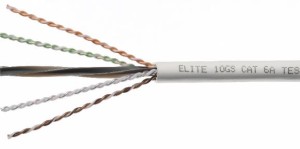
An Ethernet cable can be compared to an electrical power cord in that it can only extend a limited distances because of the electrical transmission properties. Meanwhile, wireless technologies (Bluetooth and Wi-Fi or local wireless technology) have enhanced the reach of Ethernet in residential and enterprise networks. The standard Ethernet cable consists of four coiled pairs that terminate at the eight pins of the clipped connector or "RJ45" at both ends of  a cable. At the wallplate is simply the female end of the same connector. The cable is made up of unshielded (UTP) or shielded twisted-pair (STP) cabling.


Shielding is not selected automatically during installations. The answer is, it affords the protection required for certain environments although there are also some downsides. One is mass. The single-shielded cable made of Ethernet weighs approximately 12 percent more than the unshielded cable. The double-shielded version is roughly 30 percent heavier. You may be putting together dozens or perhaps hundreds of individual shielded twisted-pair cables along  a  ladders tray above the ceiling, under a floor, or at the back of panels. The aggregate weight of these cables can collapse the mounting bracket.


Cable flexibility is also an important issue. Take care when you pull the cables through  conduits. The cable shielding can make installation more difficult. The sole foil shield can crack while the sharp boundaries of the shield can scrape the insulation of individual wires. This can cut the wire and cause data transmission issues.


What are the shielding options?


You have a number of shielding choices in for your Ethernet network. The single-shielded cable has the lightest protection. Double-shielded cables contain a foil and plate shield. It can ensure better protection against electromagnetic or radio frequency interference and reduce issues related to cable relocation. High-flex industrial cables are fabricated and protected for uninterrupted applications. These have special jacket materials to address industrial and outdoor concerns.

network cabling,cat6 cable

What are the advantages and disadvantages of Cat6 cabling?

7 Nov 2014

network cabling,cat6 cableAs the price of Cat6 cable has come down, the answer is yes. You get 500% more speed for about a 25% higher price. Unless you really just don't need more speed, go with Cat6.


Category6 or Cat6 cables have established standards for the Gigabit Ethernet. This variety is backward compatible with Category 5 and 5e as well as Category 3 cable. Cat6 facilitates computer networks by providing high-speed data transfer rates. Performance can be described as optimal if other components within the network are also running at gigabit speeds.


What are the upsides?


Cat6 is fast. It has the capability to handle maximum speed performance of 250 MHZ. The network includes Gigabit Ethernet along with 10-Gigabit Ethernet. With complementary routers, interface cards, switches, and patch panels a complete gigabit network is possible. Information Technology professionals are aware that Cat6 cable provides exceptionally fast network performance and gigabit speeds.


The composition is similar to Cat5 Cable. There are eight wires which are coiled together forming four pairs. With Cat6, each pair of wires is designed to be insulated from the others so it can produce twice the communications capacity of Cat5 and Cat5e. Cat6 cables plugs and ports are compatible to Cat5 and Cat5e. It may not have the same maximum speed of the computer cable but it will still function.


You can upgrade to Cat6 cable if your current network is not performing at a productive speed in retrieving and saving your data files. Even small enterprises are now thinking of installing this model because it is fast emerging as the industry standard.


However,  Cat6 cable is  more expensive. It will surely be a waste of resources in cases where greater data speeds are not needed. That is why some users opt for Cat5e which is less expensive while still providing splendid performance.


At the same time, you are not guaranteed 100 percent full speed. Sometimes, there is a misconception that purchasing a Cat6 cable will offer users the whole gigabit bandwidth on your network. The truth is Cat6 cable will only generate full speeds if all of the components in the network can function at gigabit speed. In case a single part (network card, patch panel, switch or connector) is not gigabit rated, the network may work at the slowest speed of the slowest component device.


You might be persuaded to buy Cat6 without really understanding if it will really produce the desired impact on the network. This is why it is essential to learn everything about the product before you make a decision.


Call us at 202-462-4290 before you decide so that you can get a free on-site analysis that will pinpoint your network cabling needs.

 
Network Cabling, Data Cabling

Choosing Plenum Cables for Plenum Space

5 Sep 2014

Office Cabling Network Cabling, New York City The plenum space is described as that section of the building that makes possible air movement for HVAC systems. It also provides the space for conduits of heated, conditioned and return air circulation. The distance between the structural ceiling and dropped ceiling tiles is regarded as the plenum space.


The plenum space houses communication cables for telephone and computer networks. However, increasing neglect of cables in plenum areas create a major risk in case of fire.

Read More

cable,Data Cabling ,Cat5e, Cat6/6a Cabling

CAT5E/CAT6 Cable Repair & Patching Techniques

15 Aug 2014

Network Cabling,Crimp Tool , Data CablingNetwork cables are said to be the “arteries and veins” of the communications network. The cabled system is a highly consistent platform for setting up infrastructure since the connectivity is very reliable. It is also easy to troubleshoot. However, it is not really fail-safe. Cables can get warped and sometimes snagged in ceilings. The connectors can also get broken if they are pulled to hard at the wallplate.


It does not matter whether it is Cat5e or Cat6. Cat6 is considered a better choice although, for some, cost prohibitive. When you look at it,

Read More

Cat6, Network Cabling, Data Cabling

Upgrading To Cat6 Cable

26 Jul 2014

Upgrading to Cat6 Cable: Requirements for a Corporate Office


Cat6 , Network Cabling, Data Cabling

Technology continues to evolve and adapt to corporate requirements. Data volume has increased significantly and processing capacity demands faster access. IT managers have predicted that data production will be 44 times larger five years from now. And enterprises have to process and protect that data. Moreover, the amount of data in your business network system grows constantly.


Until recently, this was accomplished using the Cat5 cable. However, limitations is now causing some problems because it has a maximum data rate

Read More

Network Cabling, Data Cabling,ladder trays

Ladder Trays For Cable Management

9 Nov 2023

 Network Cabling, Data Cabling,ladder traysCable management is an important function. There are numerous concerns that you need to consider regarding proper usage and arrangement. Having too many cables in a tray is a safety issue. It can also cause poor operational performance. And it can also make replacing and relocating a cable very difficult. So please refrain from overloading cable trays. Overhanging cable trays are mounted on ceilings or supported by a bracket at the bottom. Again, be careful because a heavy tray can fall.


Ladder trays are sometimes fitted with solid covers. They serve as protection

Read More

Network Cabling, Data Cabling,basket type cable tray

Basket Trays

3 Jul 2014

 Network Cabling, Data Cabling,basket type cable trayThe basket type of cable tray is made from wire lattice. The tray provides a foundation for data cables and it facilitates cable management since wires are mounted along and inside the tray. Data cabling is generally smaller but heavier than electrical wires because they are bundled and carried by these trays. A solid steel tray is preferred if heavier cables will be installed but steel is more vulnerable to rusting and exposure to elements. On the other hand, basket trays are lighter than solid racks.


The basket makes cable management and distribution less complicated

Read More

Network Cabling, Data Cabling , cable tray

Uses And Benefits Of Cable Trays

25 Jun 2014

 Network Cabling, Data Cabling, cable traysThe cable tray is meant to prop up insulated cables for communication and power distribution. Cables are mounted on the tray, rather than placed inside a pipe. It can be likened to the structural cog of the building’s electrical layout, as it protects the cables both inside and outside. Wires are organized properly so wire maintenance is easier.


A cable tray facilitates the process of tracking down where wires come from for repairs, and also creates effective fire sealing between wall panels.

Read More

Network Cabling, Data Cabling

Primary Uses Of Cabling Wall Conduit

19 Jun 2014

 Network Cabling, Data Cabling,Wall ConduitThe wire conduit refers to the pipe where cabling passes through. This duct protects insulation and isolates cable wiring. National and local building codes generally require the use of a particular type of conduit for safety and health reasons. The cable conduit is different from the electrical variety. You can install cabling conduits in between walls even if you will not use these pipes immediately; in fact, it is easier and more cost-effective to lay out the conduit during the construction phase.

Read More

IT Support,Data Cabling,Atlanta GA

Advantages Of Using Cat6 Cables

22 May 2014

Cat 6Category 6 or Cat 6 network copper cabling is the preferred infrastructure for Ethernet, Fast Ethernet, and Gigabit Ethernet. It has a maximum performance of 250 MHz, or 500 MHz for the more contemporary Cat6a standard. This type of cabling may be utilized for a maximum distance (end to end) of 100 meters, or 55 meters for the 10 GBASE-T networks. Aside from support for higher performance, Cat6 includes more rigid specifications for crosstalk and system noise. Although Cat6 is anticipated to surpass Cat 5 and Cat 5e cabling soon, all three cable varieties are still widely used for network installations.


Fast and Credible Performance


Most IT experts recognize this type of copper cabling for its speedy network performance due to its ability to deliver gigabit data transmission speeds. It has a parallel structure similar to Cat5 and Cat5e. These copper cables have eight wires coiled as one to form four pairs. The major difference is that one pair of the Cat 6 cable wires does not touch the others, so it can produce twice the transmission capacity of the two other models.


It is also backward compatible. The plug and port of Cat6 cable is the same as the 5 and 5e models. Thus, it can be plugged into any outlet that supports these cables. For instance, you can use the Cat 5 connection for a Cat 6 cable although it will not produce the full speed of the Cat 6 cable.


Resistance to Heat and Flexibility


Copper cables are second to silver in terms of effective conductivity, but among non-precious metals, these wires can cope with a broader load of electricity with less need for insulation. Furthermore, copper cabling has more resistance to heat, which eliminates overloading problems. They are impervious to corrosion despite their shiny surface. Copper is also more pliable, so it can be twisted without the risk of splitting. In fact, copper is used in fabricating thick wires for applications where very thin wires are required. It can also be part of an upgrade if you are looking forward to a more optimal network. Copper Cat5, Cat5e and Cat6 are the industry standards for most small to medium sized offices.


There are certain problems that deserve consideration. Such as copper cabling failure in high-performance wiring systems. Users may also need to contend with poor component performance, such as bad cable segments or connectors that do not comply with specifications. However, these problems are frequently the result of human error. So the choice of copper cabling is  still a good one.