Cat5 Cat6 Network Cabling,Washington DC

8 Network Cabling Mistakes to Avoid – Part 1

9 Nov 2017

Cat5 Cat6 Network Cabling,Washington DC Improperly installed twisted pair cabling can result in poor network performance, maintenance issues, and concealed expenses. The following article discusses eight network cabling errors to avoid. To get the best results for your cabling project, make sure to consult with a company that is experienced and provides excellent service.


Mistake No. 1: No Future Planning


If your company is moving to a new office space and new cabling will be required, it would be wise to avoid outdated technology and install equipment that will meet both your current and future needs. Labor costs will likely be the costliest aspect of the project. Although high-quality cable will not be cheap, it will be well worth the investment for your firm’s network requirements the next several years.


Mistake No. 2: Poor Cable Management


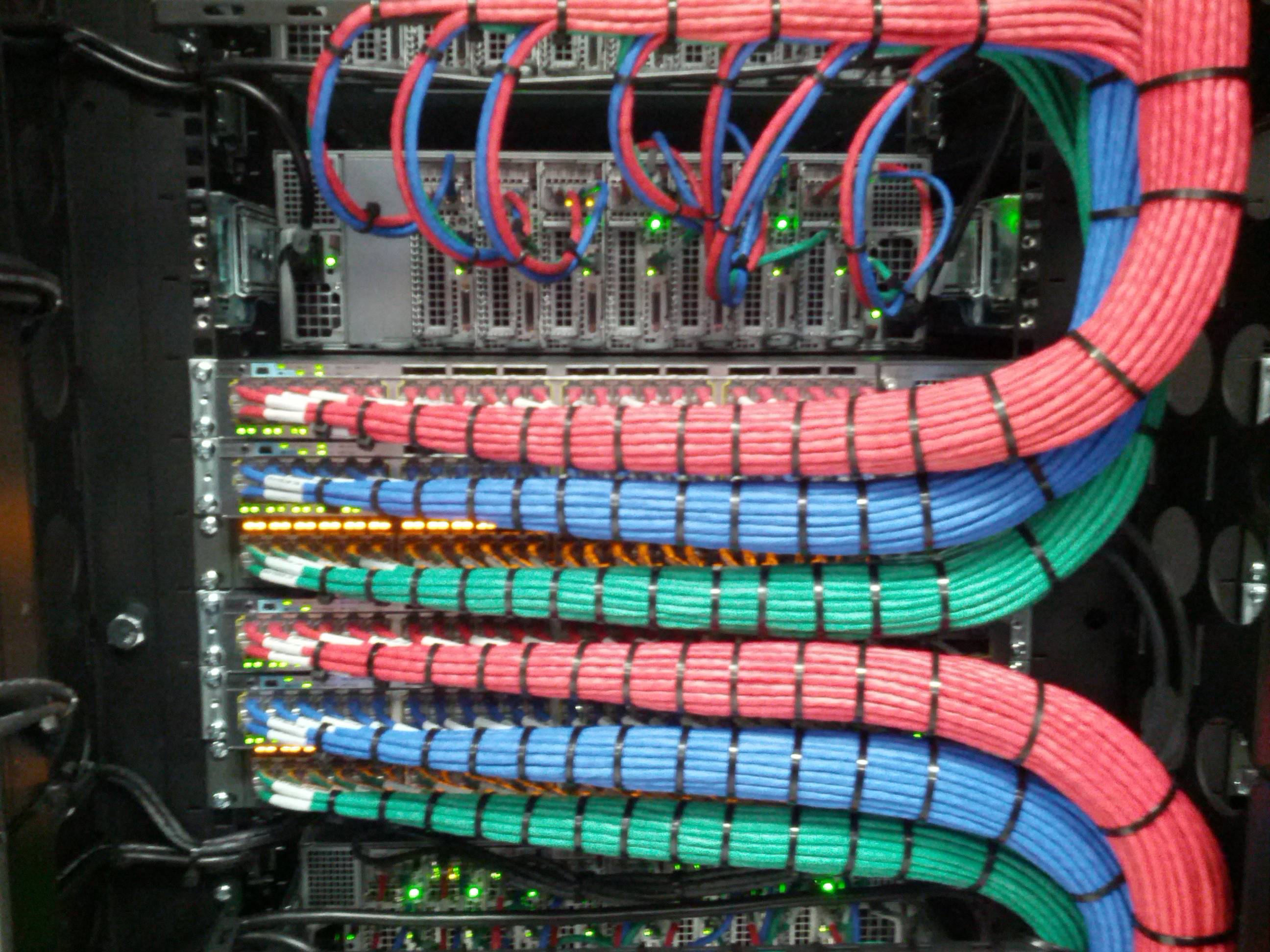
Implementing rack-based and ladder rack cable management will certainly raise the outlay for a project. However, sound cable management will ease maintenance and decrease downtime. You should be aware that cabling tasks do not end after installation. Additional cables will probably be needed, and configurations may be revised. Use a standard system for labeling and color coding cables for faster and easier identification. Doing so will speed tasks like repair, reconfiguration, and replacement.


Mistake No. 3: Parallel with Electrical Wiring


Generated by low voltage, the magnetic field conducted by data UTP (unshielded twisted pair) cables is an important feature for the conveyance of data. However, when UTP cables run parallel to electric wiring, there will be a disruption of its magnetic field. This results in garbled and noisy communication. Sometimes transmissions completely fail from point to point. Another negative effect is the extreme slowing of transmission.


Mistake No. 4: Nearby Devices and Fixtures


Noise can be introduced onto data cabling by more than just electrical wires. Fluorescent lighting, motors, and similar items that shed electrical or magnetic interference will wreak havoc on your cabling infrastructure as well. Make sure that in your planning, you leave a data cable pathway that avoids these kinds of hazards.


Part 2 will discuss four more network cabling errors to avoid.


Progressive Office Cabling


Founded in 1986, Progressive Office’s success has been a direct result of years of commitment to seeking solutions on behalf of our clients in the Washington, D.C. and New York City areas. Efficiently working together, Progressive teams get cabling installed and operating as fast as possible while minimizing disruption and downtime. Call our toll free number (800) 614-4560 today.
Structured Cabling,Washington DC New York City

The 5 Most Common Structured Cabling Errors – Part 2

28 Oct 2017

Structured Cabling,Washington DC New York CityAs mentioned in Part 1, structured cabling systems are so standardized that good practices should merely entail following ISO/IEC, CENELEC or Telecommunications Industry Association (TIA) documentation. Part 2 will discuss three more common errors of structured cabling.


Error No. 3


Failing to properly test a structured cabling system after installation is the third error. Structured cabling represents a large commitment of capital expenditure and will typically have the same length of service life as the facility itself. Ensuring that the entire system is installed to specification and the data is at the capacity and speed expected is crucial. Finally, properly testing the cabling system is required to validate the warranty.


Cables installed during the early period of construction may have been subsequently damaged by other workers performing their roles later during the project. Moreover, new cables that appear fine on the exterior may actually be faulty because of damage underneath the coating as a result of being mishandled. All cables require calibrated testing.


Error No. 4


Using unqualified technicians for installation is the fourth error. Scrimping on the quality of workers installing cabling is an unwise way to save money. Problems will eventually be revealed over time. Prior to committing to a service contract with a structured cabling service, review their credentials and confirm their references. Have conversations with previous customers whose project is similar in scope to yours. Working with a reputable structured cabling firm will help make sure your project will be successful for the long term.


Error No. 5


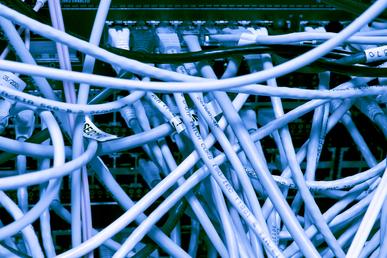
Letting structured cabling patch panels become disorganized is the fifth error. It will harm both the performance and reliability of a company’s IT systems. As time passes, the patch panel or switch ports may be damaged, causing intermittent problems that are very hard to pinpoint. The use of proper cable management hardware for supporting patch cables is good practice. Complying with the specified patching standards required for a particular structured cabling system will result in a sound and reliable network.


Progressive Office Cabling


Founded in 1986, Progressive Office’s success has been a direct result of years of commitment to seeking solutions on behalf of our clients in the Washington, D.C. and New York City areas. Efficiently working together, Progressive teams get cabling installed and operating as fast as possible while minimizing disruption and downtime. Call our toll free number (800) 614-4560 today.

Structured Cabling, Cabling, Washington DC

The 5 Most Common Structured Cabling Errors – Part 1

19 Oct 2017

Structured Cabling, cablesStructured cabling systems are so standardized that good practices should merely entail following ISO/IEC, CENELEC or Telecommunications Industry Association (TIA) documentation for panel and outlet standards, cable pathway standards, maximum cable and patch cord lengths, patch testing standards, etc. Strictly doing so will invariably result in an installation that is professional and trouble free. In addition, as data speeds grow faster and faster, following industry standards becomes even more crucial.


Improperly installed cabling made up of shorter runs, which do not overly stress the system, may function well enough. In addition, data speeds may be quite beneath the cable specification capacity. As an example, CAT5e carrying 100Mbps and capable of 1Gbps will have ample margin of error. However, structured cabling systems still need qualified technicians for proper installation supporting maximum data speeds over the entire network as required.


The following will discuss the five most common errors of structured cabling. Remember to call an experienced and expert cabling installation team to get the best results for your company’s project.


Error No. 1


Considering cables as merely wiring is the first error. They are actually very important electronic components that provide the pathway for data from point to point within a network. These points may be a desktop PC, a network switch, server, router, and wireless access point. When you consider that cables make these connections possible, then you can understand how important it is to make sure that the cabling is of high quality and properly installed.


Error No. 2


Running data cables near power cables is the second error. Even when cables are screened, this practice is unsound. When data cables are running near and parallel to   power cables, noise emitted by power cables may infiltrate data cables. As the load carried by power cables fluctuate, resulting spikes or surges may radiate into the data cables, creating undesired noise decreasing the quality of the data transmission.


Part 2 will discuss three more common errors of structured cabling.


Progressive Office Cabling


Founded in 1986, Progressive Office’s success has been a direct result of years of commitment to seeking solutions on behalf of our clients in the Washington, D.C. and New York City areas. Efficiently working together, Progressive teams get cabling installed and operating as fast as possible while minimizing disruption and downtime. Call our toll free number (800) 614-4560 today.

Cabling, network cabling, cable Installations

Fiber Optic Cabling for Your Business – Part 2

14 Oct 2017

Fiber Optic Advantages


Cabling, network cabling, cable InstallationsAs discussed in Part 1, fiber cables provide a number of advantages that make them superior to copper cables. This includes longer distance effectiveness, greater bandwidth capacity, resistance to electromagnetic interference, safer usage, and stronger security. Part 2 will discuss how fiber optic functions, its two main types, and fiber networks.


How Fiber Optic Cables Function


Fiber optic cables transmit data through the generation of pulses of light by light-emitting diodes (LEDs) or lasers. A fiber optic cable is composed of either a single strand or several strands of glass, each measuring slightly thicker than human hair.


The core is located in every filament’s center, and it is where light travels. Covered by cladding made of a glass layer, the core is able to reflect light inward, preventing signal loss and letting light travel through the cable’s bends.


Two Main Types


There are two main types of fiber optic cabling, single mode and multimode. Using extremely thin glass filaments, single mode fiber optic uses a laser to generate pulses of light, while multimode utilizes LEDs.


By utilizing the technique of Wave Division Multiplexing (WDM), single mode fiber networks raise the volume of data traffic transmitted over a filament. Combining light at various wavelengths is termed multiplexing, while separating them is called de-multiplexing. Thus, several streams of communication can be transmitted on a single pulse of light.


Fiber Networks


The installation of the majority of fiber cabling is intended to support long distance connections between national and international geographical locations. However, a number of internet service providers (ISPs) have made investments in the expansion of fiber to provide direct access to homes in suburban neighborhoods. These are termed "last mile" installations.


FTTH (Fiber to the Home) services, such as Google Fiber and Verizon FIOS, are becoming more common. They can provide homes with gigabit (1 Gbps) internet speeds. Direct fiber cabling runs directly from a main office to a single client, providing maximum bandwidth. In contrast, shared fiber cabling is ultimately distributed among several groups of users who are in close proximity.


Progressive Office Cabling


Founded in 1986, Progressive Office’s success has been a direct result of years of commitment to seeking solutions on behalf of our clients in the Washington, D.C. and New York City areas. Efficiently working together, Progressive teams get cabling installed and operating as fast as possible while minimizing disruption and downtime. Call our toll free number (800) 614-4560 today.

Technology,Network Cabling, cables

Fiber Optic Cabling for Your Business – Part 1

8 Oct 2017

Technology,Network Cabling, cablesThe widespread use of fiber optic cabling stems from 1950s research. These studies eventually made transmitting visible images via glass filament possible. This new technology was eventually used for viewing instruments and remote illumination for surgery. Subsequently, George Hockham and Charles Kao successfully achieved data transmission through glass fiber in 1966.


Fiber optic cabling is composed of glass fiber filaments housed within insulated casing, and these cables were designed for long distance, large capacity, and high performance data networking and telecommunications. In comparison to wired cables, fiber optic has high-bandwidth capability and is capable of data transmission over longer distances. Due to these properties, fiber optic cabling is used for a great portion of telephone, internet, and cable television systems around the world.


Fiber Optic Advantages


Fiber cables provide a number of advantages that make them superior to copper cabling. Due to properties of high bandwidth and low-loss, fiber optic cabling can be utilized over much greater distances than copper cables. Fiber optic cables can run up to 2 kilometers for data networks without repeaters. This is because light can travel much further on fiber cable and still retain its strength.


Fiber optic cables have greater capacity. Through the use of multiplexers, a single fiber optic cable can have the same network bandwidth as several hundred copper cables. It is now standard for fiber cables to be rated at 10 Gbps, 40 Gbps, and 100 Gbps.


Although it has special shielding as protection against electromagnetic interference, copper network cable is still susceptible when numerous cables are close to each other. This is in contrast to the physical properties of the glass used in fiber optic cables.


Fiber optic is also safer to use than copper in volatile spaces, where sparks can lead to disaster. It also has the upper hand in terms of security because tapping fiber cable to steal data transmission is very difficult.


Part 2 will discuss how fiber optic functions, its two main types, and fiber networks.


Progressive Office Cabling


Founded in 1986, Progressive Office’s success has been a direct result of years of commitment to seeking solutions on behalf of our clients in the Washington, D.C. and New York City areas. Efficiently working together, Progressive teams get cabling installed and operating as fast as possible while minimizing disruption and downtime. Call our toll free number (800) 614-4560 today.

IT Support,Data Cabling,Atlanta GA

Why Structured Cabling is Important for Business Phones

27 Sep 2017

IT Support, Data Cabling,Atlanta GAIf your organization is considering a new VOIP (Voice Over Internet Protocol) system, you should think about the structured cabling system needed to support it and maximize its potential. The following summarizes the advantages your digital phone system will have with a well-designed structured cabling system.


Decreased Noise


CAT 6 and CAT 6A cable provides more noise reduction than older cables. Fiber optic cabling is even better. Less noise resistance results in more static and faulty connections during phone conversations. Higher levels of noise also decrease network speed because the system is forced to retransmit data until it is no longer corrupted. Although purchasing lower quality cable saves money in the short run, it may result in long term business losses because of slower response times and annoyed customers.


Lengthened Runs


Higher quality cable will be capable of supporting longer runs that are free of artifacts and errors. Fiber optic cables are not restricted by the length of runs. It is the superior option for a data center or business telephone system because of its excellent noise resistance and high speed. Although second choices, CAT 5e to CAT 6A cabling are capable of supporting runs to 100 meters without noise. Cables that can support long runs provide greater flexibility for layouts, decreasing the need for data hubs or repeaters and increasing reliability.


Maintenance Savings


CAT 5e, CAT 6, and fiber optic cables are highly dependable. However, if they ever become faulty or the network needs to be reconfigured, a structured cabling system that is well organized and diligently marked will save time spent on maintenance. While a company’s network is down, business may be impacted, resulting in lost revenue. Tracing faults is made much easier by a sound structured cabling system.


Transmission Speed


Business is often time-sensitive, and you will want to use the highest quality cable your company can afford. CAT 6A cable is capable of supporting a maximum of 10 Gigabits per second while CAT 5e can only achieve 100 mbps. Older, less capable cables are not recommended because their slow data transmission and high noise levels cannot meet current VOIP demands.


Progressive Office Cabling


Founded in 1986, Progressive Office’s success has been a direct result of years of commitment to seeking solutions on behalf of their clients in the Washington, D.C. and New York City areas. Efficiently working together, their teams get cabling installed and operating as fast as possible while minimizing disruption and downtime. Call their toll free number (800) 614-4560 today.

Structured Cabling,Washington DC New York City

Important Considerations for Structured Cabling

13 Sep 2017

 cables,structured cabling, Network CablingAn infrastructure for enterprise communications, structured cabling is a system of hardware and cables designed for flexibility and future capability. Complying with the Electronic Industry Alliance/Telecommunications Industry Association (EIA/TIA), conventional structured cabling meets the organization’s standards internationally. The following are three important aspects of structured cabling that every organization should consider.


Savings


Over time, IT infrastructure has become more condensed and more sophisticated, and the importance of structured cabling has grown. Structured cabling eases a company’s expansion via a design that allows the adoption of additional hardware and software. As it has consistent network architecture, structured cabling allows the simplification of maintenance and repair, decreasing costs of upkeep. A study by the International Engineering Consortium discovered that standardizing cabling components and reducing cable delivery methods decreased startup construction outlay by almost a third. Moreover, expenses for network maintenance are lowered 40%.


Trends


Structured cabling is gradually making the transition from copper cabling to fiber optic because companies desire greater speed and better air circulation for the reduction of cooling costs. Lighter and narrower cables allow an overhead system of cabling to be installed instead of raised-floor cabling. The installation and management of cabling is made easier by less cumbersome cables, and so this trend will grow over time.


Planning


Sound planning is crucial for the success of IT projects. The future number of users, their locations, and required bandwidth must be diligently considered. How PoE (Power over Ethernet) will provide power to devices via must be studied. As Wi-Fi use grows, the number of wireless access points must be determined by every enterprise. Where will cables be located inside and outside the premises? Will the structured cabling be able to cope with moves and changes within the premises? Scalability and flexibility are both important, and so the locations of furniture and server racks must be carefully planned with respect to cabling. IT staff should also understand that different types of cable have limitations as to the length of their respective runs. Finally, there may be government regulations for structured cabling that require compliance.


Progressive Office Cabling


Founded in 1986, Progressive Office’s success has been a direct result of years of commitment to seeking solutions on behalf of their clients in the Washington, D.C. and New York City areas. Efficiently working together, their teams get cabling installed and operating as fast as possible while minimizing disruption and downtime. Call their toll free number (800) 614-4560 today.

Network Cabling,Washington DC New York City Atlanta GA

Cabling Tips for Data Center Management

1 Sep 2017

Network Cabling,Washington DC, New York City, Atlanta GAWhenever there is an IT systems issue, the resolution can often be delayed by poorly structured cabling. Enterprises often turn to their IT staff or an electrical contractor for cabling, but they would be wiser retaining a professional cabling service with years of experience. The following are important cabling tips for data center management.


Highest Quality for Budget


As expected, higher quality cabling materials are more costly, but have superior performance. For example, gold connectors have greater resistance to corrosion, but they will also be more expensive than lower-quality connectors. If your firm’s cabling will be difficult to access or located in a corrosive environment, cables with gold connectors will be the right choice.


Cabling Capable of Company Volume


Category 5, 5E and 6 are cable types and each has its own capabilities in terms of the amount of data carried, speed of transmission, and distance covered. Consult with a professional network cabling service to discuss your present and future requirements in order to select the proper cabling.


Fiber Optic for the Future


Companies expecting large data volumes in the future or requiring longer distances should select fiber optic cables. Retain expert cabling professionals because fiber optic installation will entail particular requirements that can be complex.


Accurate Measuring for Planning


When the recommended span is exceeded, cable becomes more vulnerable to distortion, degrading data quality and speed. IT staff with limited experience may not properly measure the entire distance by not accounting for corners or obstacles.


Margin for Future Modifications


The office may be reconfigured or cable connections may be moved in the future. Thus, it would be wise to allow some margin for future modifications by providing plentiful slack for each cable installed.


Labeling for Organization


An IT team should know precisely where a cable starts and terminates. Clear labeling enables faster tracing of faults, minimizing downtime and resulting losses in revenue. Cabling service professionals carry out proper labeling as a matter of routine.


Progressive Office Cabling


Founded in 1986, Progressive Office’s success has been a direct result of years of commitment to seeking solutions on behalf of their clients in the Washington, D.C. and New York City areas. Efficiently working together, their teams get cabling installed and operating as fast as possible while minimizing disruption and downtime. Call their toll free number (800) 614-4560 today.

structured cable management

Structured Cabling’s Six Subsystems – Part 2

28 Aug 2017

structured cable management,DCAs mentioned in Part 1, a structured cabling system is a type of open network structure that can be used by data, telephony, access control, building automation, and other systems. Its advantages are operational flexibility and economy. Part 2 will describe each of structured cabling's six subsystems below.


The Six Subsystems


1. Entrance Facilities


Entrance facilities house the protection devices, network demarcation points, cables,  connecting hardware, and other equipment that connect to private network cabling or the access provider. Connections between the inside building and outside plant cabling are included.


2. Equipment Room


Featuring environment control, the centralized area for telecommunications equipment is typically more complex than a telecommunications room. Usually containing the main cross-connect, it may also house the horizontal and intermediate cross-connects.


3. Backbone Cabling


Backbone cabling provides the interconnections between entrance facilities, telecommunications rooms, equipment rooms, etc. Typically, backbone cabling is comprised of fiber optic cables, intermediate and main cross-connects, mechanical terminations, and patch cables utilized for backbone-to-backbone cross-connections.


4. Telecommunications Room


Housing the terminations of backbone and horizontal cables to connecting hardware with patch cords or jumpers, a telecommunications room may also house the intermediate cross connects or main cross connect for different portions of the backbone cabling system. This space is a controlled environment containing telecommunications equipment, connecting hardware, and splice closures.


5. Horizontal Cabling


Extending from the work area’s telecommunications information outlet to the telecommunications room, the horizontal Network Cabling consists of horizontal cables and mechanical terminations, along with the jumpers and patch cords located in the telecommunications room. The system may also incorporate consolidation points and multi-user telecommunications outlet assemblies.


6. Work Area


The work area’s components typically extend from the telecommunications outlet/connector end of the horizontal cabling system to the work area equipment. At least two telecommunications outlets should be installed in every work area. If utilized, multi-user telecommunications outlet assemblies (MUTOAs) are a component of the work area.


Progressive Office Cabling


Founded in 1986, Progressive Office’s success has been a direct result of years of commitment to seeking solutions on behalf of their clients in the Washington, D.C. and New York City areas. Working together, their cabling teams get cabling installed and operating as fast as possible while minimizing disruption and downtime. Call their toll free number (800) 614-4560 today.

Structured cabling,Network Cabling, Washinton DC

Structured Cabling’s Six Subsystems – Part 1

22 Aug 2017

cable management,Network Cabling,Washinton DcA structured cabling system is a type of open network structure utilized by data, telephony, access control, building automation, and other systems. Its advantages are operational flexibility and economy. A structured cabling system is typically divided into these six subsystems: 1) Entrance Facilities, 2) Equipment Room, 3) Backbone Cabling, 4) Telecommunications Room, 5) Horizontal Cabling, and 6) Work Area.


Overview


Structured cabling is the design and installation of a cabling system that can provide support to several hardware use systems, and be suitable for both the needs of the present and the future.


Governed by international standards regarding the wiring of data centers, offices, and apartment buildings for data or voice communications, structured cabling design and installation utilizes several types of cable. These are typically CAT5e and CAT6, along with fiber optic cabling and modular connectors.


Defining methods and specifications for the laying of cabling in various topologies for meeting customer needs, standards typically require the use of a rack-mounted central patch panel from which modular connections can be used as required. Every outlet is then patched into a network switch for network usage or into a PBX (private branch exchange) or IP telephone system patch panel.


The use of color code patch panel cables is common for identifying the type of connection. However, it is not required by structured cabling standards with the exception of the demarcation wall field.


Cabling standards require that all eight conductors of CAT5e, CAT6, and CAT6A cable are connected to discourage "doubling-up" or the use of one cable for both data and voice. However, IP telephone systems are capable of running both telephone and the computer on the same wire.


When copper cabling, CAT5e, CAT6, or CAT6A is used, the maximum distance is 90 meters (98 yards) for the permanent link installation, along with an allowance of 10 meters (11 yards) for patch cords at the combined ends. Both CAT5e and CAT6 are capable of running Power over Ethernet (PoE) applications up to 90 meters. Due to power dissipation, CAT6A performs better and more efficiently.


Part 2 will summarize each of structured cabling's six subsystems.


Progressive Office Cabling


Founded in 1986, Progressive Office’s success has been a direct result of years of commitment to seeking solutions on behalf of their clients in the Washington, D.C. and New York City areas. Working together, their cabling teams get cabling installed and operating as fast as possible while minimizing disruption and downtime. Call their toll free number (800) 614-4560 today.