Data Cabling,Structured Cabling,Washington DC

How Improper Cabling Causes Network Issues – Part 1
5 Sep 2018

Data Cabling Structured Cabling Washington DCYour employees are dissatisfied by their company’s network performance, and it is affecting their productivity. A number of factors must be taken into consideration. How many users are attempting to use resources simultaneously? Have you taken into account how much the use of devices has grown? Is your network equipment sufficient to meet demand? Answering the above questions will help, but network issues may be directly related to your company’s structured cabling.


Outdated Cabling


In many instances, the age of your structured cabling system may be responsible for poor network performance. 15-year-old cabling may have met standards when it was installed, but now it may be unable to handle the ever increasing network traffic needs of your company.


An internet service provider (ISP) provides the cable that provides the connection from your company’s network to the internet. When this backbone component fails to meet today’s bandwidth standards, bottlenecks may occur.


In situations where you are attempting to operate at speeds that are too high or carry excessive bandwidth via a cable that not rated for the capacity, it will be noticeable to users and their productivity will decline, hampering business operations.


Quality of Cabling


Cabling manufacturers rate their cables in terms of capability and performance. For example, CAT6 and CAT6a cabling have different capabilities, CAT being an abbreviation for category. A manufacturer must meet the performance standards set by the Telecommunications Industry Association (TIA) for each category of cabling.


Cabling that exceeds minimum standards will attain higher network speeds without having to upgrade your cabling. In contrast, for cabling that only meets the minimum standards, the company network speed will be unable to expand much beyond the rating of the cable.


It is helpful to understand cable standards and ratings. Even though a cable is labeled Category 6A, it is not automatic that it meets the minimum performance standards of this category. The brand name and manufacturing quality will play a big role in the cable’s output.


Part 2 will discuss Compatibility, Patch Cords, and Poor Installation.


Progressive Office Cabling


Founded in 1986, Progressive Office’s success has been a direct result of years of commitment to seeking solutions on behalf of our clients in the Washington, D.C., Atlanta, Pittsburgh and New York City areas. Efficiently working together, Progressive teams get cabling installed and operating as fast as possible while minimizing disruption and downtime. Call our toll free number (800) 614-4560 today.


;
Office Cabling Network Data Cabling

Office Cabling for Performance and Efficiency – Part 2

31 May 2018

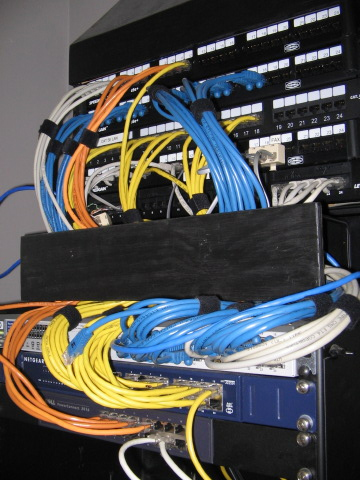
Office Cabling Network Data CablingAs discussed in Part 1, office space has become very valuable and costly in many cities. Some companies will need to implement space optimization, and designing their structured cabling network is a good place to start. Part 2 will discuss Cabling System Performance and Densification of Networks.


Cabling System Performance


The TIA 568 standard sets the limit for runs of copper cable to 90 meters (295 feet) from floor distributor to workstations. Exceeding this length will cause greater signal losses or insertion loss and delay limitations due to the Ethernet protocol, which can decrease the performance of the network.


An expansive floor size with a proper number of floor distributors will oftentimes result in cables longer than 90 meters and greater insertion losses. Moreover, short cable runs are affected by crosstalk and return loss.


Due to the increasing implementation of 2.5, 5G, and 10G Ethernet, along with the newest high performance WAP (wireless access points), it is crucial to install a category cable, such as CAT6A, capable of handling higher bandwidth demands in the future.


Densification of Networks


Horizontal distributor optimization inside the equipment room will result in increased floor space and improved network densification. The optimization of floor distributors can improve the usage of LAN Ethernet switches, minimizing intra-building backbone runs. Implementing optimized distributor placement will ease the management of the network and increase reliability.


The use of fiber and copper panels with higher port density should also be considered by network managers. One way to gauge design efficiency is to calculate the number of ports per unit of rack space. This assessment will result in the optimization of rack space, decreasing racks and maximizing floor space.


Using wall-mounted panels for terminating cables and easing their management should also be considered. This will also ensure the prioritization of LAN equipment and fiber panels for rack space. This method suits companies who desire the convergence of building applications and IP networks.


Progressive Office Cabling


Founded in 1986, Progressive Office’s success has been a direct result of years of commitment to seeking solutions on behalf of our clients in the Washington, D.C. and New York City areas. Efficiently working together, Progressive teams get cabling installed and operating as fast as possible while minimizing disruption and downtime. Call our toll free number (800) 614-4560 today.

Structured Cabling,Network Cabling ,Data Cabling Washington DC

The Benefits of Structured Cabling for IT Infrastructure

28 Apr 2018

Structured Cabling,Network Cabling ,Data CablingUtilizing best practices developed over time, structured cabling determines the design and construction of an organization’s IT infrastructure. Standardized practices ease modifications and additions and promote compatibility and reliability. The following will discuss the benefits of structured cabling for your organization’s IT infrastructure.


Efficiency


There will be times when it will be necessary to move forward with changes to your IT infrastructure. When this involves dealing with improperly placed cables without a labeling system, each project will take longer than what would be necessary for a well-organized system. Structured cabling’s best practices decrease downtime and minimize mistakes.


Flexibility


Structured cabling allows flexibility, meaning repairs and changes to the infrastructure become easier and faster to perform. This means data center managers will not hesitate to implement needed changes because they don’t have to deal with disorganized cabling that make their jobs much harder.


Future Proofing


The perpetual improvements of telecommunications technology make it crucial to have an IT infrastructure that can adapt to future technical advances. Structured cabling makes this possible by ensuring upgrades are not difficult to integrate with the existing system. Structured cabling enables future proofing, and so it can be considered a sound investment for companies anticipating expansion.


Redundancy


Structured cabling allows the creation of an IT infrastructure that features redundancy, which helps ensure reliability and accessibility, particularly during maintenance or repair. If a cable is somehow compromised, data communications can keep functioning over redundant cabling as repairs are being performed.

ROI


Business owners should consider structured cabling as an investment that will improve their IT infrastructures. As it will significantly increase the efficiency of its data operations, the ROI (return on investment) could far exceed the initial outlay for implementation over time.


Progressive Office Cabling


Founded in 1986, Progressive Office’s success has been a direct result of years of commitment to seeking solutions on behalf of our clients in the Washington, D.C. and New York City areas. Efficiently working together, Progressive teams get cabling installed and operating as fast as possible while minimizing disruption and downtime. Call our toll free number (800) 614-4560 today.

Network Cabling, Cabling Installations New York City Atlanta GA

Your First Conversation with a Cabling Installation Company

26 Feb 2018

Network Cabling, Cabling Installations New York City Atlanta GANow that your business is ready to install new cabling or perform an upgrade, you will be meeting with a cabling installation company that has been vetted to discuss the project. Typically, the contractor will ask several standard questions to gain a good understanding of the project and make an evaluation. The questions are organized under topics and discussed in the paragraphs below.


Moving


When does your business plan to move? If the move is in the next two months, have arrangements been made for the phone or T1 lines with the telecommunications provider?


Although this is a key component when moving an office, many companies neglect it. Some telecoms need a 45-day notice for a T1 installation, so your move must take this into account.


Voice and Data Drops


What will be the number of voice and data drops required? A drop is a cable run usually starting from a server room or wiring closet and terminating at a cubicle, workstation, or office. Keep in mind that each station will typically require a drop for each computer and telephone line. Drops will also be needed for office equipment such as fax machines and network printers.


Construction


What kind of construction was done at the new office location? Does it have a hard cap ceiling, which most houses have, or a drop/acoustic ceiling? Facilitating access for running cables, drop ceilings are far easier than hard cap ceilings for installations, modifications, and upgrades.


Cabling Type


Is plenum or non-plenum cabling needed at the new office location? When cabling has to run over a ceiling where the space is already utilized for a HVAC (heating, ventilation, and air conditioning) system, then plenum-rated cable will be required because of its fire retardant and smoke-limiting capabilities. Plenum is a bit more expensive, but required to comply with code.


Phone System


Will the current phone system be transferred to the new office? The cabling installation company may not be capable of handling the type your business is using, therefore a subcontractor may be retained to handle this aspect of the project as it requires specialization.


Progressive Office Cabling


Founded in 1986, Progressive Office’s success has been a direct result of years of commitment to seeking solutions on behalf of our clients in the Washington, D.C. and New York City areas. Efficiently working together, Progressive teams get cabling installed and operating as fast as possible while minimizing disruption and downtime. Call our toll free number (800) 614-4560 today.

Structured Cabling,Network Cabling ,Data Cabling Washington DC

Is Up-to-Date Structured Cabling Crucial for Your Business?

31 Jan 2018

Structured Cabling,Network Cabling ,Data Cabling Washington DCIf you are busy running a business every day, you probably don’t consider the IT infrastructure of your company very often. However, if you let it become outdated, you will make your enterprise un-competitive and prevent it from achieving its potential.


Think of your IT network as the transport system for your data and some of the services your firm provides. Using structured cabling is the best way to ensure its efficiency. This system is advantageous because it allows the connection, movement, and removal of devices without needing new cables every time there is a change.


A structured cabling system that is up-to-date can run optimally in the present and also allow a company to readily expand in the future as its business grows. The following are five advantages of a structured cabling system.


Decreased Maintenance Costs


Replacing old cabling with superior high-quality cabling will ensure better performance and longevity. Structured cabling also makes it much easier to trace and repair problems, resulting in less downtime and monetary losses from maintenance work. The unification of data, voice, and video on a single IT network will also reduce the time needed for maintaining and repairing components.


Ease of Management


The consolidation of cabling under a single system that can handle data in several formats will be much easier to manage than a disorganized system of multiple point-to -point wiring. Structured cable also allows longer cable runs, which help decrease errors and interference affecting data. Cabling will also be easier to remove and install.


Greater Speeds


Slow data transmission hurts the bottom line because time is money. If your company still has obsolete CAT3 cables, upgrade to CAT5e or CAT6 cables to keep up with your competitors. Fiber optic cables will provide even better performance. Upgrading will also allow your organization to more easily expand when more bandwidth is needed.


Less Clutter


A well-organized office projects the desired image for clients and customers. It also helps promotes company pride among employees. Clutter and poor data transmission caused by bundles of disorganized wires and cables will be eliminated by the simplified organization of structured cabling.


Progressive Office Cabling


Founded in 1986, Progressive Office’s success has been a direct result of years of commitment to seeking solutions on behalf of our clients in the Washington, D.C. and New York City areas. Efficiently working together, Progressive Office teams get cabling installed and operating as fast as possible while minimizing disruption and downtime. Call our toll free number (800) 614-4560 today.

Cable Installation, Cabling, Washington D.C.

Ethernet Crossover Cable Basics

24 Jan 2018

Cable Installation, Cabling, Washington D.C.The crossover cable connects two Ethernet network devices to each other. They were invented for temporarily supporting host-to-host networking when a network router or another intermediary device is not available. Although crossover cables appear the same as a standard straight-through (patch) Ethernet cable, their internal wiring structures are different.


Straight Through vs. Crossover


A straight-through cable is used for connecting two different kinds of devices, such as a network switch to a computer. In contrast, a crossover cable is for connecting two devices that are identical.


The straight-through cable’s ends can be wired in any manner, but both ends must be identical. This is different from the crossover cable’s internal wiring, which reverses the signals for receiving and transmitting. The first and third wires and the second and sixth wires are crossed.


High-quality Ethernet crossover cables have special markings which allow users to distinguish them from straight-through cables. They are often red in color and the word "crossover" will appear on its casing and packaging.


Crossover Cable Needs


Crossover cables came into use during the 1990s and 2000s because the most common types of Ethernet were unable to support direct cable connections between hosts. Intended for using specific wires for both receiving and transmitting signals, the original and Fast Ethernet standards required the communication of two endpoints through an intermediary device to avoid conflicts.


The Ethernet feature MDI-X has auto-detection for the prevention of signal conflicts, enabling the Ethernet interface to automatically determine and negotiate the expected signaling convention of the device at the other end of the cable. The majority of home broadband routers and Gigabit Ethernet adopted MDI-X.


As a result, crossover cables are only necessary for the connection of two Ethernet client devices if they are not configured for Gigabit Ethernet. Nowadays, Ethernet devices are compatible with crossover cables because they can automatically detect them.


Ethernet Crossover Cables Usage


Crossover cable usage should be limited to direct network connections. When a user tries connecting a computer to an antiquated router or network switch via a crossover cable rather than a standard cable, the link can be prevented from working.


Progressive Office Cabling


Founded in 1986, Progressive Office’s success has been a direct result of years of commitment to seeking solutions on behalf of our clients in the Washington, D.C. and New York City areas. Efficiently working together, Progressive Office teams get cabling installed and operating as fast as possible while minimizing disruption and downtime. Call our toll free number (800) 614-4560 today.

Structured cabling Network Cabling Washington DC

Advantages of Upgrading to Structured Cabling – Part 1

4 Jan 2018

Structured cabling Network Cabling Washington DCIf it has been a while since your company has upgraded your network cabling, you and your team may not be achieving your potential. As you know, an organization’s IT network is the very heart of its operations. Lacking a network that is up-to-date, staff members will not be as efficient and productive as possible.


Updating from Point-to-Point Cabling


The update that yields the most benefits is having your network make the transition from an outdated point-to-point cabling system to a far more effective structured cabling system. As you may know, there are only two ways for transmitting data over network cables. Numerous companies persist on using point-to-point cabling. Unfortunately, it tends to become problematic, especially when a company needs to significantly expand the network’s size and capabilities. Let’s dig deeper to understand the reasons.


Point-to-point cabling directly connects a switch, device, network, a server, or network, to another network component via fiber optic cable. For the last few decades, this wiring method provided an innovative way to swiftly build a network. However, during that period, the majority of networks at IT departments were not large.


Nowadays, as networks expand and speedy transmissions of massive data amounts become routinely expected, the maintenance of outdated point-to-point cabling systems, along with the thousands of cables required for operations, becomes a large burden on a company’s IT resources.


As a result, organizations have transitioned to structured cabling systems. Rather than directly connecting every single network component to another, a structured cabling system directly links storage units and servers to a communication backbone.


Installed in every part of a facility, local cabling panels are linked to the communication backbone with only one cable. This enables users to easily connect their devices to the whole network by connecting a cable to the nearest cabling panel.


Part 2 will discuss the advantages of upgrading to Structured Cabling.


Progressive Office Cabling


Founded in 1986, Progressive Office’s success has been a direct result of years of commitment to seeking solutions on behalf of our clients in the Washington, D.C. and New York City areas. Efficiently working together, Progressive Office teams get cabling installed and operating as fast as possible while minimizing disruption and downtime. Call our toll free number (800) 614-4560 today.

Structured Cabling,Washington DC New York City

Structured Cabling’s Top Ten Tips

31 Dec 2017

Structured Cabling,Washington DC New York CityStructured cabling that is properly installed can help your business grow by helping to improve its network performance and IT capability. The following will discuss structured cabling’s Top Ten Tips for installing cabling systems.


#1 Cable Labeling


Although cable labeling will slow installation, it will help save lots of time and effort during future repair, reconfiguration, and maintenance tasks.


#2 Cable Testing


Ensure every cable is tested and confirmed to be functioning properly during the installation process. A cable with a nominal performance should not be utilized as it may decrease overall system performance.


#3 Short Patch Cables


Do not use long patch cables when they aren’t required. They are inefficient, look disorganized, and are prone to tangling.


#4 Select Quality Terminations


Avoid purchasing cheap terminating cables because time will be unnecessarily spent on troubleshooting in the future. Select those that are of high quality and terminate properly and rapidly.


#5 Avoid Overheating


Keep in mind that maintaining proper cable temperatures to avoid overheating is crucial for stable and reliable network performance.


#6 Measure 2X, Cut 1X


Precise measurements prior to cutting will minimize damaged and wasted cables during installations.


#7 No Kinky Fiber Cables


As fiber cables have great flexibility, they can kink bend, and knot. These will result in flaws in the fiber cables, negatively affecting performance of the network.


#8 Maximum Cable Length


Do not exceed the maximum length of a cable run, which is typically 100 meters for network cabling systems.


#9 Allow for Expansion


Network cabling systems should always have room for interior expansion. As a business grows, its network should have the room to be able to upgrade or expand.


#10 Qualified Installation Company


In order to ensure that a company’s network cabling system will be properly installed, management must select a qualified installation company and request references.  Their technicians should be BICSI certified and experts in ANSI standards.


Progressive Office Cabling


Founded in 1986, Progressive Office’s success has been a direct result of years of commitment to seeking solutions on behalf of our clients in the Washington, D.C. and New York City areas. Efficiently working together, Progressive teams get cabling installed and operating as fast as possible while minimizing disruption and downtime. Call our toll free number (800) 614-4560 today.